


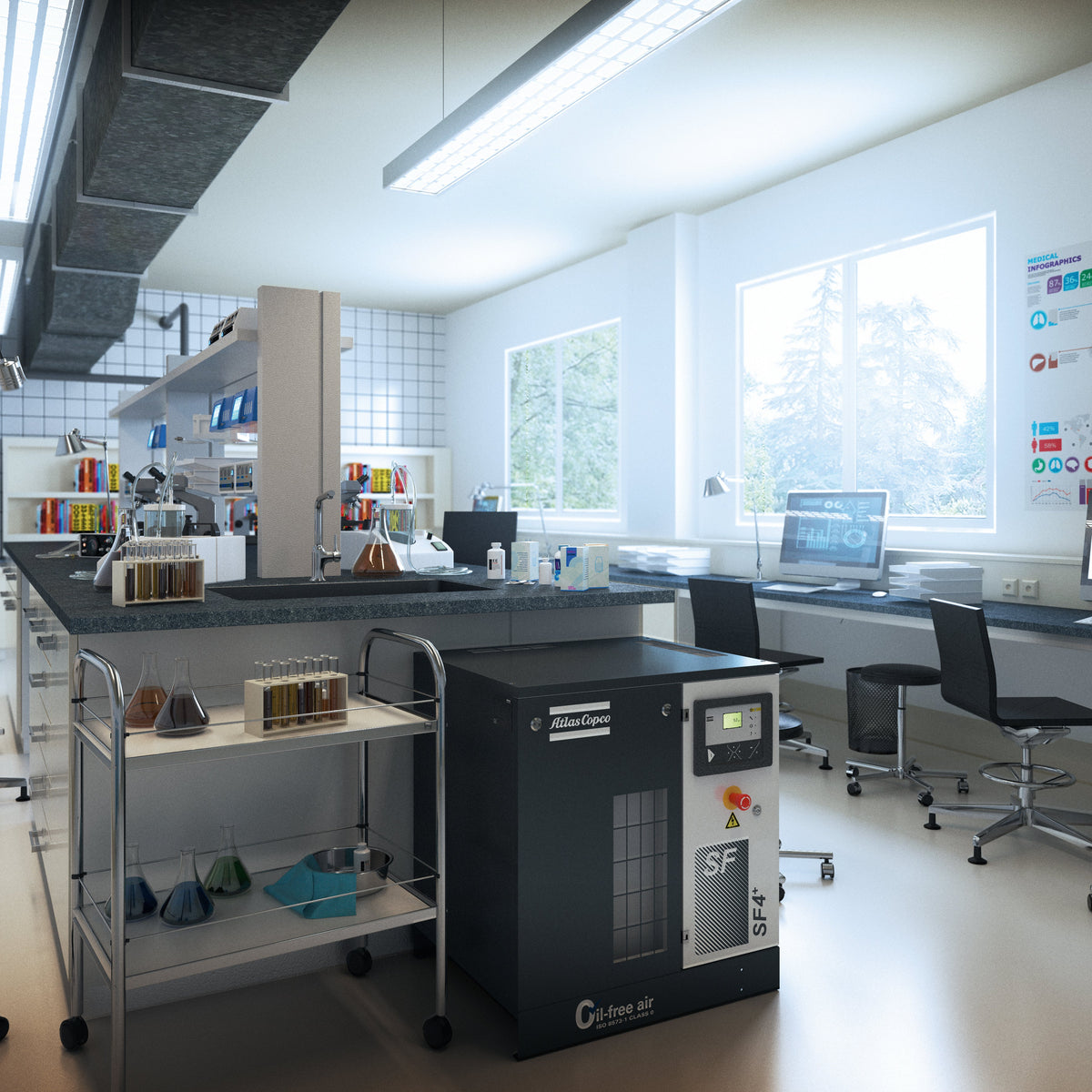
A lab manager called us last spring because a GC baseline had started wandering and two months of method validation were in question. The instrument tech had already swapped the column and the septa. The problem turned out to be a shared house air line: somebody had tapped the lab air header in the building's machine shop for a die grinder, and the oil aerosol from that leg had worked its way back into an actuator manifold.
That is the thing about lab air. When it fails in a machine shop, a cylinder gets sticky and somebody notices in an hour. When it fails in a lab, nothing bangs and nothing stops. You just get data you cannot trust, and you find out weeks later.
Compressed air for laboratories is a small system with a big consequence, and it gets specified wrong more often than almost anything else we quote.
What Lab Air Is Actually Doing
Walk a typical analytical or research lab and the air is feeding more than people expect:
- Pneumatic actuators inside instruments: autosampler arms, valve manifolds on LC and GC systems, switching valves
- Fume hood sash controls and variable air volume dampers
- Glassware and column drying at the bench
- Venturi aspirators and vacuum generators where a small local vacuum beats running house vacuum
- Air driven stirrers and small mixers, common in flammable or classified areas where an electric motor is a problem
- Biosafety cabinet and isolator controls
- Cage washers and autoclaves in vivarium and animal facilities
- Pneumatic tube transport between labs and specimen receiving
Total demand is usually modest, often somewhere between 5 and 40 cfm for a single lab floor. What is not modest is the purity requirement and the consequence of getting it wrong.
Where We Fit, and Where We Do Not
Worth being direct about this before you read the sizing section, because labs are a place where the words get mixed up constantly.
We supply the compressed air source and the treatment train: the compressor, the dryer, the filtration, the receiver, the piping, the drains. That is the air that runs your actuators, your hoods, your aspirators and your bench work.
We do not supply laboratory gas generators. Zero air generators for FID makeup, hydrogen generators for carrier gas, nitrogen generators built and certified to an analytical purity spec, and calibration gas standards are a different product category with different certification behind them. Those usually sit downstream of a compressed air supply, and plenty of them take clean compressed air as their feed, which is where we come in. Buy the generator from an analytical instrument supplier. Buy the air that feeds it from us.
Same answer on medical air. If you are in a hospital lab drawing from a certified NFPA 99 medical air system, that package is a regulated build and not something we do.
The Purity Target
Labs live and die on ISO 8573-1, and the number that matters most is the oil class.
| Where the air goes | ISO 8573-1 target | What that means in practice |
|---|---|---|
| Instrument actuators, valve manifolds, autosamplers | Class 1.2.1 or better | Oil-free source, coalescing plus carbon, dew point around -40F if the instrument spec calls for it |
| Feed to a zero air or nitrogen generator | Whatever the generator manufacturer specifies, commonly 1.4.1 | Read their spec sheet and hit it exactly. Undersized feed treatment kills generator media fast |
| Fume hood and VAV damper actuators | Class 2.4.2 | Dry and clean, but these are not analytical devices |
| Bench air, glassware drying | Class 1.4.1 | Oil is the issue here, moisture less so, because it contacts samples and glassware |
| Cage wash, autoclave, general facility | Class 3.4.4 | Ordinary plant air quality is fine |
Class 1 for oil caps total oil at 0.01 mg per cubic meter. You do not get there reliably by filtering a lubricated compressor and hoping. You get there by not putting oil in the air in the first place. Our ISO 8573-1 breakdown explains what each digit in a class code commits you to.
Picking the Machine
Oil-free, and usually scroll
For a lab in the 5 to 40 cfm range, scroll compressors are the default and for good reason. They are genuinely oil-free in the compression chamber, they run quiet enough to sit in an occupied building, they have very few wearing parts, and they modulate well by staging multiple scroll modules in one cabinet so a 20 cfm package can run efficiently at 6 cfm on a slow Tuesday.
Oil-free reciprocating machines cost less and are easier to service in a small space. They are louder and they wear faster. For an academic lab on a tight capital budget with a maintenance shop down the hall, they are a reasonable pick. For a regulated lab or a quiet floor, scroll is worth the money. Browse oil-free compressors by capacity.
If you want the head to head on the three oil-free designs, including where diaphragm and rocking piston units fit and the flow and duty ranges each one actually survives, we go through it in oil-free laboratory air compressors: scroll, piston, or diaphragm.
What you should not do is buy a lubricated screw and a very good filter train and call it lab air. It can be made to work for facility loads. It should not be feeding an analytical instrument.
Redundancy, because a lab does not stop
A single compressor feeding a building full of running experiments is a single point of failure with a very expensive failure mode. Two smaller machines in a duplex arrangement usually cost about the same as one large one, give you N+1, and let you service one without shutting the floor down. On a lab floor this is nearly always the right answer.
Sizing Without Guessing
Lab demand is genuinely hard to estimate from a device list, because so much of it is intermittent and hidden inside instruments. Some working numbers:
| Load | Typical demand | Duty |
|---|---|---|
| GC or LC pneumatics per instrument | 0.5 to 2 cfm | Continuous while running |
| Fume hood sash actuator | Well under 1 cfm average | Intermittent, brief |
| Venturi aspirator | 2 to 5 cfm each | Continuous while in use, and this adds up fast |
| Bench blow-off gun | 4 to 10 cfm while triggered | Very intermittent |
| Air driven stirrer | 1 to 3 cfm | Continuous during a run |
| Cage washer | 5 to 15 cfm | Cyclic |
Add up the loads that genuinely run at the same time, add the intermittent peaks, then add about 30 percent. Aspirators are the item that surprises people: three venturi generators running all afternoon can be a bigger continuous load than every instrument on the floor combined.
Put a receiver in even on a small system. A receiver tank at roughly 4 to 6 gallons per cfm keeps a small compressor from short cycling itself to death on a load that is mostly brief pulses, and short cycling is the number one killer of small lab compressors.
Treatment Train for a Lab
- Oil-free compressor
- Wet receiver
- Dryer sized at the real inlet temperature. Refrigerated at a 35 to 38F dew point covers most indoor lab air. Go desiccant to -40F only where an instrument spec or a generator feed demands it
- Particulate then coalescing filtration
- Activated carbon where air contacts samples or feeds an analytical device
- Point of use filter and regulator at each bench drop
The point of use stage matters more in a lab than almost anywhere else, because your piping is often older than your instruments and the contamination you are guarding against may already be inside the pipe. See our filters and elements for the hardware.
Noise, Heat, and the Occupied Building Problem
A lab compressor usually cannot go in a separate mechanical building the way a plant compressor can. It goes in a closet off a corridor, or in a mechanical space shared with people.
That drives three decisions. Target a package under about 60 dBA so it does not intrude on an office or a lab bench through a shared wall. Ventilate the closet, because an oil-free machine rejects the same heat as any other and a hot closet raises both the discharge temperature and the moisture load your dryer has to handle. And leave real service clearance, because the day somebody has to pull a scroll module in a closet with 12 inches on each side is the day the project gets expensive.
What Labs Get Wrong
Sharing a header with the shop. The story at the top of this article is the most common failure we see. Facility air and lab air should be separate systems, or at minimum the lab leg should have its own dedicated treatment and a check valve so nothing migrates back.
Buying to today's instrument count. Labs add instruments constantly and never remove them. Size for the bench space you have, not the bench space you have filled.
Ignoring the generator feed spec. If a nitrogen or zero air generator says it needs a specific inlet air class, that is not a suggestion. Feeding it dirty or wet air destroys the media and voids the warranty, and the replacement media costs more than the filtration would have.
No dew point monitoring. A lab that claims an air quality class in its quality system needs to be able to show the number. A dew point transmitter with an alarm is cheap next to a deviation investigation.
Running house air pressure to the bench. Most lab devices want 60 to 90 psi and some instrument pneumatics want far less. Regulate at the drop.
Frequently Asked Questions
Does a laboratory need an oil-free compressor?
For anything feeding an instrument, contacting a sample, or feeding a gas generator, yes. ISO 8573-1 Class 1 oil means 0.01 mg per cubic meter total, and the reliable way to hit that is to not introduce oil at the source. Facility loads like cage washing and autoclaves can run on ordinary lubricated plant air.
Is a scroll compressor better than an oil-free piston for a lab?
Usually. Scroll runs quieter, lasts longer between service events, and modulates well across the light loads labs actually run. Oil-free pistons cost less up front and are simpler to service, which makes them reasonable for a budget-constrained lab with in-house maintenance, but they are louder and wear faster.
Can this air feed my nitrogen or zero air generator?
Yes, and that is a common setup, but only if you hit the inlet specification the generator manufacturer publishes. Read their required ISO class and build the treatment train to it. We supply the compressor and treatment; the generator itself comes from an analytical gas supplier.
Refrigerated or desiccant dryer for lab air?
Refrigerated at a 35 to 38F pressure dew point handles most indoor lab air. Move to desiccant at -40F only when an instrument specification, a generator inlet requirement, or piping through an unheated space forces it. Desiccant costs purge air and capital you may not need.
How loud is too loud for a compressor in a lab building?
Aim under about 60 dBA for a unit that shares a wall with occupied space. Above that you are into noise complaints and, in a space where people are concentrating, real disruption. Enclosed scroll packages generally meet it and open-frame oil-free pistons generally do not.
Where to Start
Separate the lab leg from facility air, add up what actually runs at the same time, set the ISO class by application rather than buying the cleanest thing in the catalog for every drop, and build in a second machine so a service call does not stop the floor. Most of what goes wrong with compressed air for laboratories comes down to a lab being fed by a system that was designed for a building.


