


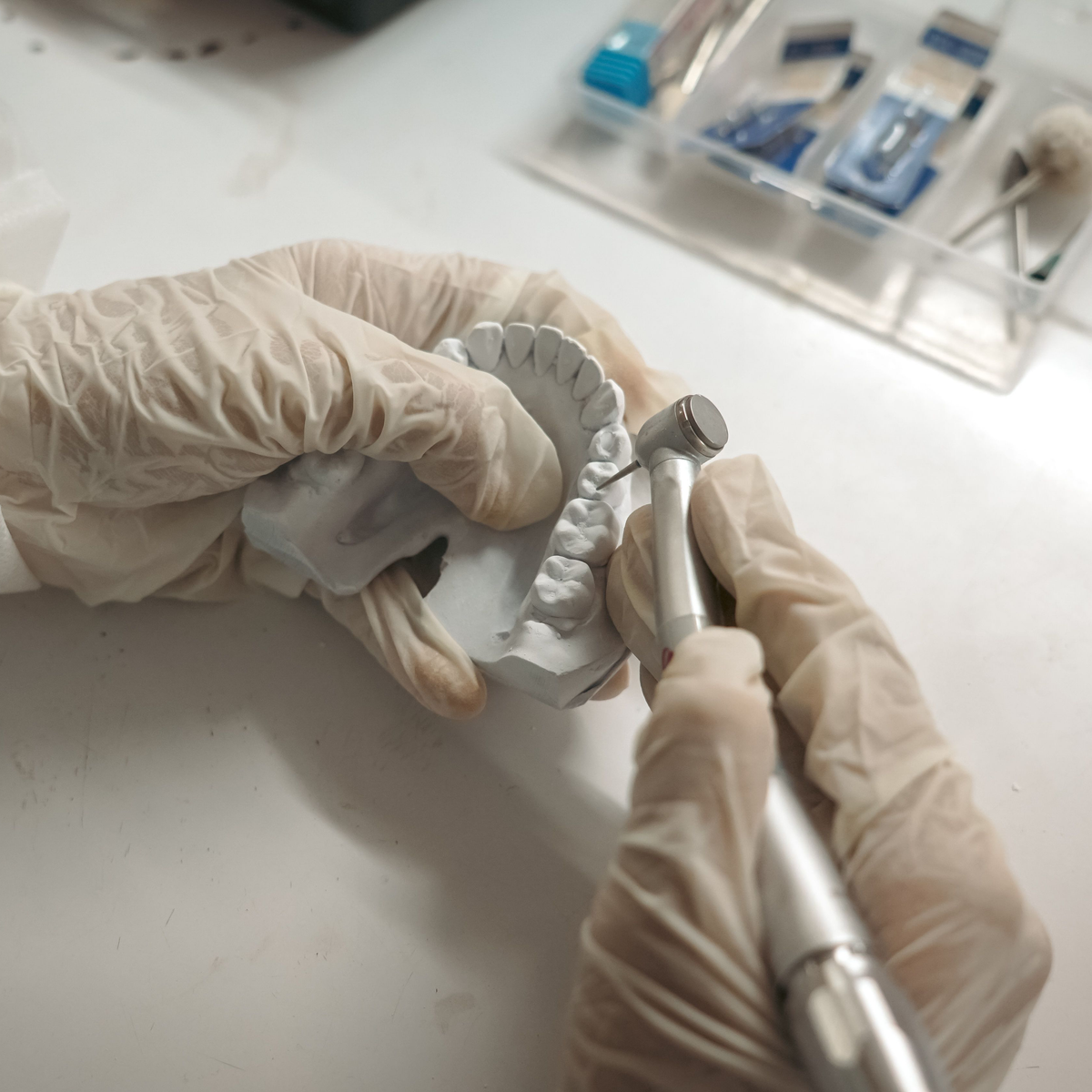
A lab owner called last year because his new five axis mill kept aborting jobs with a pressure fault. He had moved the mill onto the same compressor that fed the bench blasters and the model trimmer, and every time a tech hit the blaster the header dropped eight psi. The mill did not care that it was only for two seconds. It faulted, and a zirconia bridge went in the trash.
Dental labs get squeezed between two assumptions. People assume lab air is like dental office air, which it is not, and they assume a mill is just another air tool, which it definitely is not. Compressed air for a dental lab is a continuous duty, high purity, pressure stable system, and it is closer to a small precision machine shop than to an operatory.
How a Lab Differs From an Operatory
If you also work on the clinical side, you already know the dental office air compressor story: oil free, small, intermittent, driven by handpiece demand during patient hours.
A lab inverts almost all of that.
| Dental office | Dental laboratory | |
|---|---|---|
| Duty cycle | Intermittent, follows the schedule | Effectively 100 percent while the mill runs, and mills run overnight |
| Pressure | About 80 psi at the handpiece | Often up to 10 bar, roughly 145 psi, at the mill |
| Dominant load | Handpieces | CAD/CAM mill, then blasters |
| Air quality driver | Patient safety | Machine protection and restoration quality |
| Consequence of bad air | Infection control problem | Scrapped units and a mill spindle repair |
The duty cycle line is the one that catches people. A lab mill cutting a full arch can run for hours unattended, and the compressor is loaded the whole time. Piston compressors sized for an operatory are generally rated for a 50 to 75 percent duty cycle and will cook themselves on a lab schedule.
The Air Quality Spec
There is an actual standard here, which is unusual for a small shop environment. ISO 22052 covers compressed air quality for dentistry, and the CAD/CAM equipment makers typically call for ISO 8573-1 Class 2:4:0 at the machine.
Read that class from left to right:
- 2 for particles. Filtered to 1 micron. Grit from a blaster or scale from a steel pipe will destroy a spindle air bearing.
- 4 for water. A pressure dew point of about plus 37 degrees F, which is what a refrigerated dryer or a good membrane dryer delivers. Moisture in a mill means corrosion inside the machine and poor adhesion downstream.
- 0 for oil. Class 0 is the strictest class, meaning the supplier has data to back something better than Class 1. In practice, this is what pushes labs to oil free compressors. Oil on a zirconia or lithium disilicate surface shows up as a bond failure or a stain after sintering, and you usually do not find out until the case is finished.
If the class notation is new to you, we unpacked it in ISO 8573-1 air quality classes decoded. The practical summary for a lab: oil free compressor, a dryer that actually holds its dew point, a particulate filter and a coalescing filter, and point of use filtration at the mill.
Why Oil Free Rather Than Filtered
You can filter a lubricated compressor down to Class 1 oil, and in a machine shop that is a perfectly good answer. In a lab it is a bad risk for a simple reason: your failure mode is invisible and delayed. A trace of oil carryover does not fault the mill. It contaminates a surface, the case goes through sintering and glazing, and a crown debonds in somebody's mouth three months later. Browse oil free air compressors and take the risk off the table.
Sizing It
Start with the mill, because the mill is both the largest and the least forgiving load.
| Equipment | Typical demand | Notes |
|---|---|---|
| Dry mill, 4 or 5 axis | 7 to 15 CFM at 90 to 145 psi | Chip blow off runs continuously during a cut |
| Wet mill | 3 to 8 CFM | Lower air demand, coolant does the clearing |
| Bench sandblaster, fine abrasion unit | 3 to 6 CFM | Intermittent, but used all day |
| Bench blaster, larger cabinet | 8 to 20 CFM | This is what causes the pressure sag |
| Air driven handpieces at the bench | 2 to 4 CFM each | Short bursts |
| Model trimmer, air blow off, dusting | 2 to 8 CFM | Everybody underestimates blow off |
| Vacuum investing and pressure pots | 1 to 5 CFM | Check whether yours uses venturi vacuum, which is an air hog |
A one mill lab with three or four benches typically lands between 15 and 30 CFM of real demand. That is a 5 to 7.5 HP oil free machine, or a pair of smaller scroll units. A multi mill production lab goes well past that and should be looking at an oil free rotary screw with a proper treatment train.
The Pressure Stability Problem
This is the part that is specific to labs and the part that gets people. A mill wants stable pressure, often near 10 bar, and a bench blaster is a step load that dumps the header in a second. Three fixes, in order of how often they are the right answer:
- Put a buffer tank right at the mill. Local storage absorbs the blaster hit so the mill never sees it. Cheapest and usually sufficient.
- Run a dedicated line to the mill from the compressor, properly sized, rather than teeing it off the bench header. The OEMs recommend this for a reason.
- Give the mill its own compressor. The right call in a production lab, and the only real answer if you run multiple mills overnight.
Also check the pressure the mill actually wants. If it calls for 10 bar and your compressor cuts out at 125 psi, you never had enough pressure to begin with, and no amount of plumbing fixes that.
Drying: Refrigerated, Membrane, or Desiccant
Class 2:4:0 only asks for a plus 37 degree F pressure dew point, so the dryer choice is less dramatic than in food or pharma. What matters is that it holds that dew point at 100 percent duty.
- Membrane dryers are common on packaged dental lab compressors, run silently, have no moving parts, and keep working during continuous operation. They lose a small amount of sweep air, which is the tradeoff.
- Refrigerated dryers are the standard choice once you are past a few horsepower, and they cost less to run at larger flows.
- Desiccant is overkill for a lab unless your lines run through an unconditioned attic or an unheated back room, in which case a plus 37 dew point will still drop water when the pipe gets cold.
Whatever you choose, size it on the compressor's full output and on a realistic summer inlet temperature, not on the catalog condition. Our air dryers category covers all three.
The Layout Details That Matter in a Lab
- Get the compressor out of the work area. Noise is the obvious reason. The better reason is that a lab is full of airborne gypsum, zirconia and acrylic dust, and a compressor intake pulls all of it. Put the machine in a ventilated closet or back room and duct the intake to clean air.
- Take every drop off the top of the main. Air off the top, water to a drip leg with a drain.
- Point of use filtration at the mill. A final 0.01 micron coalescing element right at the machine is cheap insurance regardless of what the central train looks like.
- Do not plumb a blaster into a line feeding the mill without storage between them. This is the single most common layout mistake in a lab.
- Grit stays downstream. Blaster exhaust and reclaim do not belong anywhere near the compressor intake.
What a Good Lab System Looks Like
Oil free compressor sized at 1.5 times measured demand, in a ventilated room away from the benches. Receiver at the compressor. Particulate filter, dryer, coalescing filter. Main header sized one size up, with drops off the top. A buffer tank at the mill with a point of use coalescing filter and a regulator set to the OEM pressure. Benches fed off a separate branch so a blaster cannot pull the mill down.
That is a system that mills all night and does not produce surprises in the morning.
Frequently Asked Questions
What air quality does a dental CAD/CAM mill require?
Most CAD/CAM manufacturers specify ISO 8573-1 Class 2:4:0, meaning 1 micron particulate, a pressure dew point of about plus 37 degrees F, and Class 0 oil. ISO 22052 is the standard covering compressed air quality in dentistry. In practice that combination points to an oil free compressor with a dryer and two stages of filtration, plus point of use filtration at the machine.
Can I run my lab mill off the same compressor as the operatory?
Only if that compressor is sized for continuous duty and can hold the mill's pressure. Office compressors are sized for intermittent handpiece demand and typically carry a 50 to 75 percent duty rating, while a mill can run for hours. If you share a machine, at minimum run a dedicated line to the mill with a buffer tank at the machine.
Why does my mill fault when somebody uses the sandblaster?
Step load. A bench blaster can pull 8 to 20 CFM the instant the trigger goes down, which drops header pressure faster than the compressor can respond. The mill sees the sag and faults. A buffer tank at the mill, or a separate line to it, fixes this for a few hundred dollars.
Do I really need an oil free compressor in a lab?
It is the safer answer, yes. A filtered lubricated compressor can meet a low oil class on paper, but a trace of carryover in a lab does not announce itself. It shows up later as a bond failure or a surface defect after sintering, by which point the case is finished and shipped. Class 0 as specified by the mill makers is what pushes most labs to oil free.
What pressure should a dental lab compressor be set to?
Work backward from the mill. If the machine wants 10 bar, roughly 145 psi, your compressor has to be rated for that pressure and still deliver its CFM there, not just reach it. Set the cut out high enough that after losses through the dryer, filters and pipe you still have the OEM pressure at the machine, and regulate the bench side down separately.
Where to Start
Put a gauge at the mill and watch it while somebody runs a blaster. If it moves more than a few psi you have found your first problem and a buffer tank will fix it. After that, verify what your mill actually asks for in both pressure and air class, because that single line in the manual sets the spec for the whole system. Getting compressed air for a dental lab right is mostly about treating the mill as the precision machine tool it is.


