


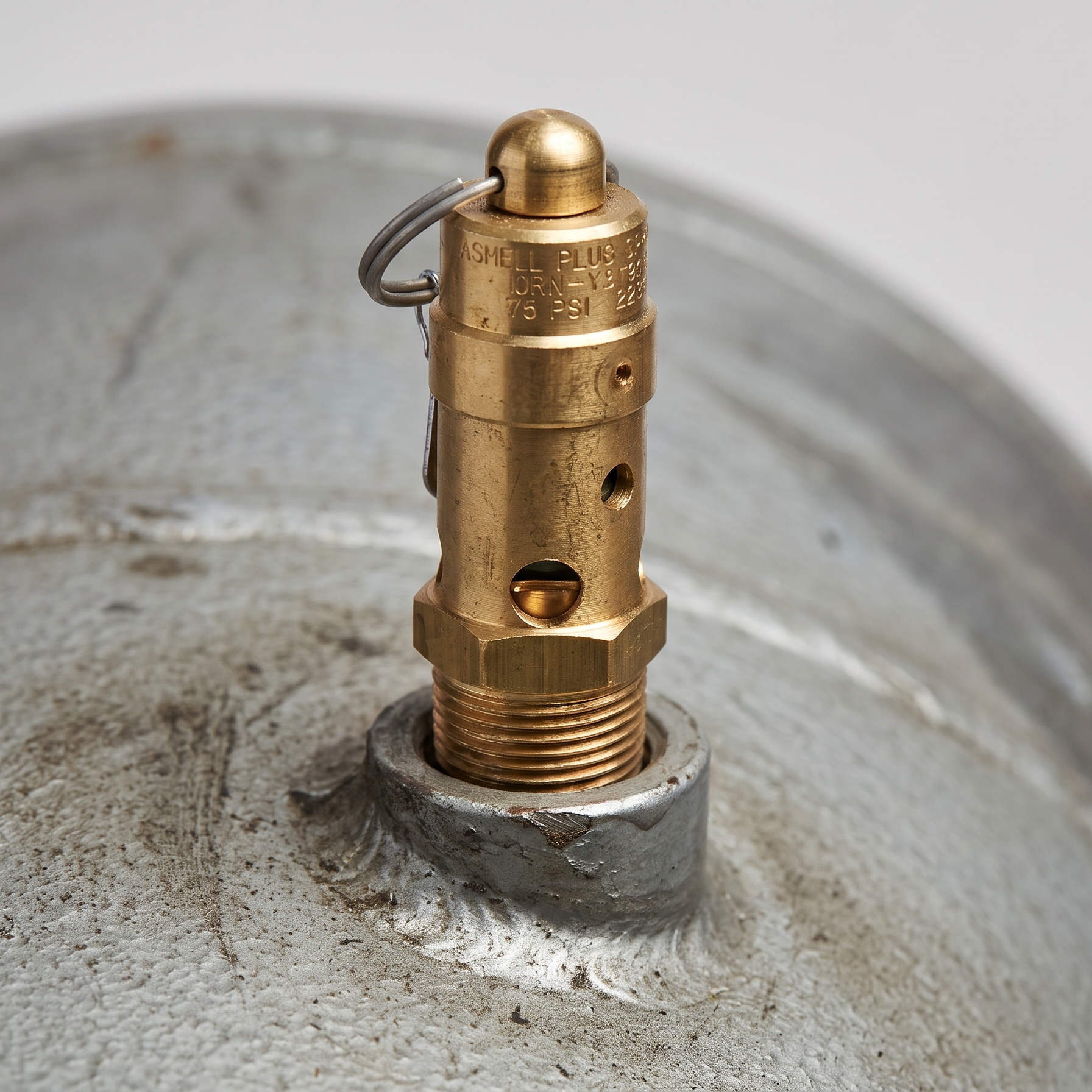
It is the cheapest part on your compressor and the one you least want to find out about the hard way. The little brass valve with the pull ring sticking out of your tank is the air compressor safety relief valve, and it has exactly one job: open and dump air before your tank ever sees a pressure it cannot handle. Most people never think about it until a pressure switch sticks and that valve is suddenly the only thing standing between a normal day and a ruptured tank.
So let us give it some attention. Here is how a safety relief valve works, how to check that yours still does, and how to pick the right replacement when it is time.
What a safety relief valve actually does
An air compressor safety relief valve is a spring loaded valve threaded into your tank or manifold. Inside, a spring holds a disc down against a seat, sealing the air in. The spring is set to a specific pressure. As long as tank pressure stays below that number, the valve stays shut and you never know it is there.
When tank pressure climbs past the spring setting, the air pushes the disc up off its seat and vents to the atmosphere with a loud hiss. That is the valve doing its job. The instant pressure drops back below the setting, the spring pushes the disc back down and reseals. It is purely mechanical, which is the whole point. It does not need power, a sensor, or a controller. If everything else on the machine fails, this part still works.
People call it a few things: safety valve, pop off valve, pressure relief valve, or release valve. They all mean the same component doing the same thing.

How the pressure ratings work
Safety valves follow a standard, and it helps to understand it before you buy a replacement. Under the ASME rules that cover air tanks, the valve is built to reach full discharge capacity when pressure is within 10 percent above its set pressure, and to close back up once pressure falls below 90 percent of that set point.
Put real numbers on it. A valve set at 150 PSI should be wide open and flowing its full rated capacity by about 165 PSI, and it should reseat once pressure drops back under roughly 135 PSI. That small window is by design. It lets the valve open hard and fast in an emergency, then close cleanly without chattering once the danger passes.
This is also why you never want a valve rated way above your tank. The valve has to protect the tank, so its set pressure needs to be at or below the tank's maximum rating, and above the compressor's normal cutout pressure so it does not weep every cycle. Get that relationship right and the valve sits quiet until it is genuinely needed.
Picking the right replacement valve
Replacing a safety valve is a five minute job, but only if you buy the right one. Three things have to match.
| Spec | What to match |
|---|---|
| Set pressure (PSI) | At or below your tank's max rating, above the compressor's cutout. Match the valve you are removing unless it was wrong to begin with. Common ratings are 125, 150, 165, 175, and 200 PSI. |
| Thread size | The port it screws into, commonly 1/4 inch NPT on smaller tanks, larger on bigger vessels. Measure or match the old one. |
| Flow capacity (SCFM) | The valve must be able to vent at least as fast as your compressor can produce. An undersized valve cannot relieve pressure quickly enough to protect the tank. |
That last one trips people up. A valve that fits the threads but cannot flow enough air is not really protecting anything, because the compressor can out produce it. When in doubt, match the original valve's rating and capacity, or step up the flow, never down. You can find correctly rated units in our safety relief valves collection, sorted by pressure and thread size so you can match yours quickly.
How to test your safety valve
You should check the valve on a regular schedule, and it takes about a minute with the tank under pressure. Here is the routine:
- Run the compressor up to its normal operating pressure so the tank is charged.
- Put on eye and ear protection. The valve is loud and it blows debris.
- Pull the ring or lever on top of the valve for a second or two. You should hear a strong, sharp blast of air.
- Let go. The valve should snap fully shut and stop completely, with no lingering hiss or weep.
If the valve does not release when you pull the ring, or if it keeps leaking after you let go, replace it. Do not try to clean, lubricate, or adjust a stuck safety valve back to life. It is a cheap part and a critical one, and a valve you cannot trust is worse than no test at all. Never plug, cap, or screw down a valve that is weeping, since that defeats the only thing protecting your tank.
Signs your valve needs attention
A safety valve gives you warning signs before it fails outright. Watch for these:
- It weeps or hisses constantly, even below the set pressure. The seat is worn or there is debris under the disc.
- It does nothing when you pull the test ring. The valve may be seized, which is the most dangerous failure mode.
- It pops off early, well before normal cutout. The spring has weakened or the rating is wrong for your machine.
- The brass is corroded, cracked, or the ring has broken off. Time to replace it regardless of how it tests.
Any one of these means swap the valve. They are inexpensive, and on a tank that holds a few hundred PSI, this is not the corner to cut. While you are at it, give the rest of the tank a look. If you are servicing an older receiver, our air compressor tanks and the valves and gauges that go with them are all in one place, and full air compressor packages already come with the right relief valve fitted.
Don't confuse it with the unloader valve
This is a mix up we see at the counter a lot, so it is worth clearing up. Your compressor has more than one valve that lets air out, and they do completely different jobs.
The unloader valve is the little fitting tied to your pressure switch that releases the air trapped over the pump head every time the compressor shuts off. That quick puff of air you hear when the motor stops is the unloader doing its work, so the motor can restart against an empty head instead of a loaded one. It fires on every cycle, by design, and it is not a safety device.
The safety relief valve, by contrast, should stay silent during normal running. It only opens if pressure climbs past its setting, which should never happen unless something has gone wrong upstream, like a pressure switch that failed to cut out. If your relief valve is venting on every cycle, it is either rated too low or the machine is overshooting its cutout, and that is worth chasing down. One valve is routine. The other is your last line of defense, and it speaking up means pay attention now.
Frequently Asked Questions
What pressure should my safety relief valve be set at?
At or below your tank's maximum rated pressure, and above your compressor's cutoff pressure. For most shop compressors that lands around 150 to 175 PSI. Match the valve you are replacing unless you have reason to believe it was wrong.
How often should I test the safety valve?
Pull the test ring on a regular schedule, monthly is a good habit for a working shop compressor. It takes a minute and tells you the one part you cannot afford to have seized.
Can I adjust a safety relief valve to a different pressure?
No. These valves are set and sealed at the factory for a reason, and field adjusting them defeats their certification. If you need a different set pressure, buy a valve rated for it.
Why is my safety valve leaking air?
Usually a worn seat or debris holding the disc open, or a valve that is rated too low and is relieving every cycle. Try one firm test pull to clear light debris, but if it keeps weeping, replace it. Do not cap or plug it.
Is it safe to run my compressor with a leaking relief valve?
It is safe in the sense that a leaking valve still relieves pressure, but it wastes air and tells you the valve is failing. Replace it promptly. A valve that leaks today can seize shut tomorrow, and a seized valve protects nothing.
It is easy to overlook a five dollar part, right up until it is the only thing doing its job. Test your air compressor safety relief valve on a schedule, match the pressure and flow when you replace it, and never defeat one that is acting up. It is the simplest insurance policy your air system has.


