


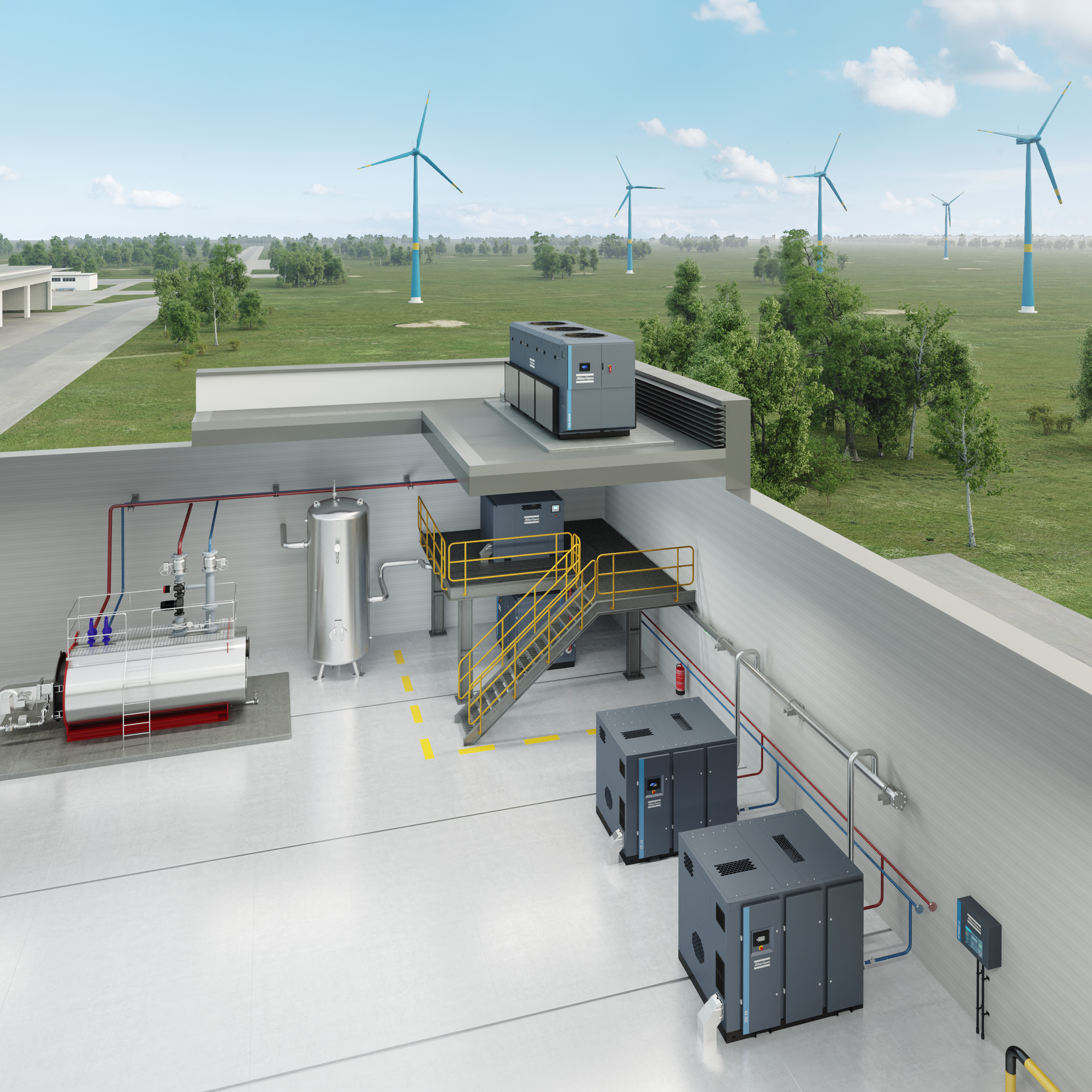
A customer called last month with a rotary screw that kept tripping on high temperature every afternoon. His shop got hot, the incoming cooling water got hotter, and by two o'clock the compressor was shutting itself down to protect the airend. He did not need a bigger compressor. He needed steady cooling, and that is exactly the job process chillers are built for.
A process chiller is a closed-loop refrigeration unit that cools a fluid, usually water or a water and glycol mix, and pumps it where you need it. In the compressed air world that fluid feeds a water-cooled aftercooler, a heat exchanger, or the compressor's own cooling jacket, pulling heat out of the air and the machine so both run at a safe, consistent temperature. It is not the same thing as a refrigerated air dryer, and mixing those two up is where a lot of money gets wasted.
What process chillers actually do
Think of a chiller as a refrigerator for water. Inside, a compressor, a condenser, and an evaporator move heat from your cooling loop out to the surroundings. Warm water comes back from your process, passes over the cold evaporator, gives up its heat, and leaves cold again. A pump and a reservoir keep that loop circulating at a set temperature all day, no matter how hot the shop gets.
On a compressed air system there are three common reasons to add one:
- Your compressor is water-cooled and your plant water is too warm, too dirty, or too expensive to run to drain. A closed chiller loop gives the machine clean, cold water and stops wasting city water.
- You want lower air temperature going into your dryer and filters. Cooler air drops out more water before it ever reaches the dryer, so everything downstream works less hard.
- You have a process, like a laser, a spot welder, or plastic tooling, that runs off the same clean, cold water and you want one reliable source for all of it.
Chiller or dryer? They are not the same
This is the part worth slowing down on, because the words sound similar. A refrigerated air dryer cools the compressed air itself to knock moisture out, then reheats it, and it is sized in SCFM of air. A process chiller cools a separate water loop, and it is sized in tons or BTU of heat removed. You can run both. In fact a chiller upstream of a dryer makes the dryer's life easier. But a chiller does not replace a dryer, and a dryer cannot cool your compressor jacket. Pick the tool for the job.
| Process chiller | Refrigerated air dryer | |
|---|---|---|
| What it cools | A water or glycol loop | The compressed air stream |
| Sized in | Tons or BTU per hour | SCFM of air |
| Main job | Cool the machine or a process | Remove water vapor from the air |
| Typical dew point | Not a dew point device | Around 35 to 39 degrees F |
Air cooled or water cooled?
Chillers come in two flavors based on how they dump the heat they collect. An air-cooled chiller blows the heat off with a fan, like a car radiator. It is simpler to install, needs no cooling tower, and works well in most shops as long as the room can shed the extra heat. A water-cooled chiller sends its heat to a cooling tower or a separate water source. It is quieter, more efficient in hot rooms, and better for very large loads, but it is a bigger install.
For most compressor rooms an air-cooled unit is the practical pick. Just make sure the space has enough airflow and is not already a heat trap, because an air-cooled chiller adds heat to the room it sits in.
How to size process chillers
Sizing looks intimidating but it comes down to how much heat you need to remove and how cold you need the water. Cooling capacity is measured in tons, and one ton equals 12,000 BTU per hour. Here is the basic math for a water loop:
BTU per hour = flow in GPM x 500 x temperature drop in degrees F
Say your process returns water at 62 degrees and you need it back at 50, a 12 degree drop, flowing at 40 gallons per minute. That is 40 x 500 x 12, or 240,000 BTU per hour. Divide by 12,000 and you get 20 tons. Then add a safety factor of 10 to 20 percent for a hot day and future growth, so call it 22 to 24 tons.
A couple of rules of thumb help you sanity-check that number. At a 10 degree temperature difference, water flow runs around 2.4 GPM per ton. And every real ton of cooling has to cover the heat load plus the pump work, which is why the safety factor matters. If you are cooling a compressor rather than a process, the machine's data plate or manual will list the heat rejection, and that number, not a guess, is what you size to.
Glycol, freeze protection, and upkeep
If any part of the loop runs cold enough to freeze, or the chiller sits where it can get cold in winter, you add glycol to the water. A 30 to 50 percent glycol mix protects against freezing but it also lowers the fluid's ability to carry heat, so you size up a little to make up for it. Do not overdo the glycol. More than you need just hurts efficiency.
The maintenance is straightforward and it is the same discipline as the rest of your air system. Keep the condenser coil clean so the unit can shed heat, check fluid level and glycol concentration, watch the supply temperature for drift, and keep the strainer clear. A chiller that cannot reject heat because of a clogged coil is the summertime version of the overheating compressor we started with.
When a chiller is worth it
If your compressor is fighting high inlet water temperature, if you are pouring city water to drain to cool a machine, or if you run a process that needs clean cold water anyway, process chillers pay for themselves in uptime and water bills. If your only real problem is wet air at the tools, you want a dryer and better drainage first, and maybe a chiller later once the easy wins are done. Size it to the actual heat load, give it room to breathe, and it will keep your air system running cool on the hottest day of the year.
Frequently Asked Questions
Is a process chiller the same as an air dryer?
No. A process chiller cools a water or glycol loop and is sized in tons of heat removed. A refrigerated air dryer cools the compressed air itself to pull out moisture and is sized in SCFM. They solve different problems, and many shops run both.
How many tons of chiller do I need?
Figure the heat you must remove, then divide by 12,000 BTU per hour per ton and add 10 to 20 percent. For a water loop, BTU per hour equals GPM times 500 times the temperature drop in degrees F. If you are cooling a compressor, use the heat rejection number from its manual.
Air cooled or water cooled, which is better?
Air cooled is simpler, needs no cooling tower, and suits most compressor rooms as long as the space can shed the heat. Water cooled is more efficient for very large loads and hot rooms but needs a tower or water source and a bigger install.
Do I need glycol in my chiller?
Add glycol when any part of the loop can freeze or the unit sits somewhere cold. A 30 to 50 percent mix is common. Remember it carries heat less well than plain water, so size up slightly and do not use more than you need.
Will a chiller replace my compressed air dryer?
No. A chiller can make cooler air that drops out more water before the dryer, which helps, but it does not remove water vapor to a rated dew point the way a dryer does. Keep the dryer for air quality and use the chiller for cooling.
Not sure a full chiller is what you need? Compare your options below, and if the real issue is wet air, look at our refrigerated air dryers and desiccant air dryers first, then size cooling for the compressor itself.


