


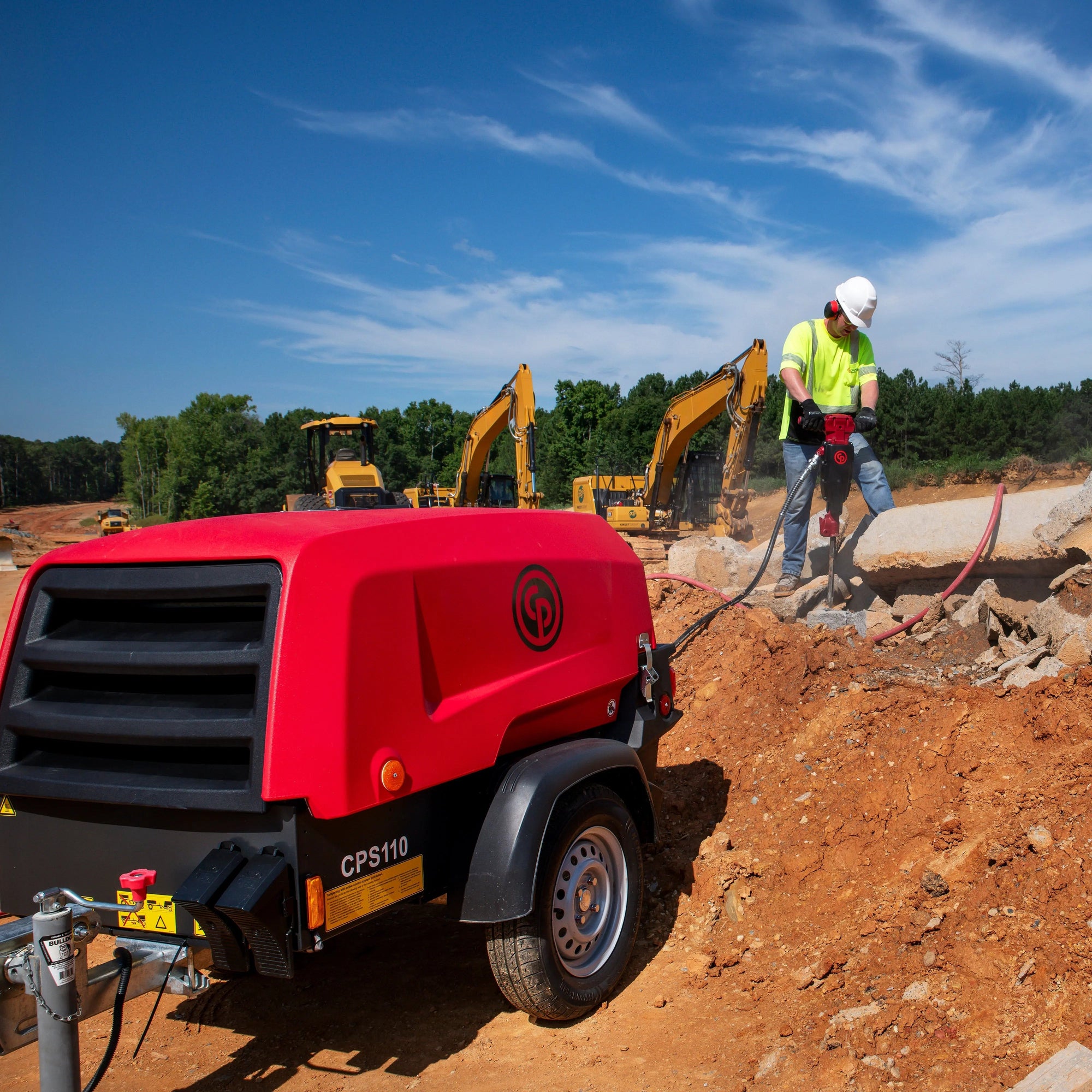
Picture a framing crew on the first day of a new build. No power pole yet, no temporary service, just dirt, lumber, and a stack of nail guns. The electric compressor back at the shop is useless out here. This is where a gas air compressor earns its keep. It makes its own power, rolls right up to the work, and keeps the nailers and breakers fed all day without an extension cord in sight.
We get asked about gas units a lot, usually by contractors who are tired of tripping breakers or who simply have nowhere to plug in. So let's walk through when a gas powered compressor is the right call, how much air you actually need, and what to watch for before you buy.

What a gas air compressor actually is
A gas air compressor swaps the electric motor for a gasoline or diesel engine. The engine spins the pump instead of a wall outlet doing it. Everything downstream of that, the pump, the tank, the regulator, works the same way it does on an electric unit. The difference is the power source, and that one change drives almost every reason you would pick one.
You will see two flavors out there. Smaller contractor units run a gasoline engine, often a Honda or Kohler, bolted to a single or two-stage piston pump on a wheelbarrow frame or a small tank. Bigger towable machines run a diesel engine turning a rotary screw element, and those put out serious continuous air. Our gas-engine compressors and towable air compressors cover both ends of that range.
When gas beats electric
The decision usually comes down to one question: do you have reliable power where the work happens? If the answer is no, gas wins by default. Here is how the two stack up.
| Factor | Gas / Engine-Driven | Electric |
|---|---|---|
| Power needed on site | None, runs on fuel | Outlet or generator required |
| Best setting | Open jobsites, remote work, mobile crews | Indoor shops, fixed locations |
| Typical airflow | Higher, built for continuous demand | Moderate, sized to the circuit |
| Indoor use | Unsafe, produces carbon monoxide | Safe with proper ventilation |
| Noise | Louder | Quieter |
| Upkeep | Engine oil, fuel, filters, spark | Less routine engine work |
Gas compressors are the only practical solution on a site with no electricity and a real appetite for air. That is most common during the framing phase of new construction, on road work, and anywhere a crew shows up before the utility does. Electric units are better for indoor or shop use where power is available and where engine exhaust would be a problem.
The carbon monoxide rule
This one is not negotiable. A gas or diesel engine produces carbon monoxide, so you never run one inside a garage, a basement, or any enclosed space, even with the door cracked. If the work is indoors, you want electric. Keep the engine outside and run the hose in.
How much air do you need?
Buy for the tools, not the engine badge. Every air tool has a CFM rating, and your compressor has to keep up with the most demanding one, plus a little headroom if more than one person is working off it. Here is a rough field guide for jobsite work.
| Work | Typical CFM range | Notes |
|---|---|---|
| Framing and carpentry | 15 to 20 CFM | Nailers and staplers, one or two users |
| Roofing, multi-crew | 20 to 30 CFM | Several tools running at once |
| Pavement breakers, demo | Higher, often 100 plus CFM | Towable diesel territory |
Add up the tools that will run at the same time, then give yourself a cushion. A compressor that is always racing to catch up will short-cycle, run hot, and wear out early. One sized with a little margin loafs along and lasts.

Gas piston vs diesel rotary screw
Once you know your CFM, the engine and pump type sort themselves out. Gasoline piston units are lighter, cheaper, and perfect for a one or two tool crew that moves around a lot. They are happiest running in bursts, not flat out all day.
Diesel rotary screw towables are a different animal. They are built for continuous duty, so they can feed breakers, sandblasting rigs, and big tools for hours without breaking a sweat. As an example, a mid-size towable rotary screw unit delivers up to 174 CFM across a 29 to 150 psi range on a single Kubota diesel, with a sound level around 70 dB(A). If your demand is steady and heavy, that is the category to shop. Our full air compressor lineup and truck-mounted compressors can match the format to how you actually move around a site.
What it costs you in upkeep
Gas means an engine, and an engine means maintenance you would not have on an electric machine. Plan on regular engine oil changes, fuel, air and oil filters, and the usual spark plug or glow plug care depending on whether it is gasoline or diesel. Many towable units run on a 1,000 hour service interval, and keeping to it is the difference between a machine that holds its value and one that nickel-and-dimes you. None of this is hard, but it is real, and you should budget the time for it.
Getting it to the work
Portability is the whole point of a gas unit, so think hard about how it actually moves. Small gasoline piston compressors come on wheelbarrow frames or compact tanks that one or two people can lift into a truck bed. They are the right answer when the machine follows a single carpenter from room to room or job to job. Step up to a larger gas or diesel unit and you are into wheeled or towable territory, with a hitch and road tires. Those stay parked outside the work and feed air through longer hose runs.
Match the format to your day. If you are constantly repositioning, a heavy towable behind a truck is a hassle for short hops. If you set up once and run all day, the towable's continuous air is worth the parking. And remember that a gas engine adds real weight over an equivalent electric pump, so a unit that looks "portable" on paper may still be a two-person lift.
Fuel, runtime, and tank size
A gas compressor is only as useful as its next tank of fuel, so plan the logistics. Gasoline units sip or gulp depending on engine size and how hard you lean on them, and you will want fuel on hand for a full day. Diesel towables are more efficient per hour of air delivered, which is part of why they dominate long jobs, but they still need a fuel plan and a place to refuel safely, away from the work and any ignition sources.
Tank size matters too, and it plays a different role than on a shop compressor. A bigger receiver tank smooths out demand spikes, so the engine is not revving up and down every few seconds when you feather a tool. For bursty work like framing, a decent tank lets the engine settle into an easy rhythm. For continuous demand like blasting, the rotary screw element on a towable is delivering air steadily and the tank mostly buffers short surges. Either way, do not buy a gas unit on horsepower alone. Airflow and tank size tell you far more about how it will feel on the job.
Quick buyer's checklist
Before you put money down, run through these: Will it ever run indoors? If yes, go electric. What is the highest combined CFM your tools will pull? Buy above it. Is the demand bursty or continuous? Bursty leans gasoline piston, continuous leans diesel screw. How are you moving it, by hand, in a truck bed, or behind a hitch? And are you ready for the engine upkeep? Answer those honestly and the right machine almost picks itself.
Frequently Asked Questions
Can I run a gas air compressor in my garage if the door is open?
No. A gas or diesel engine gives off carbon monoxide, which is colorless and deadly, and an open door does not clear it fast enough. Run engine-driven units outdoors only and route the air hose inside if you need air in an enclosed space.
Is a gas powered compressor more powerful than electric?
Generally yes for portable work. Gas and diesel units are built for higher CFM and continuous output, which is why they dominate open jobsites. Electric units shine indoors where power is available and quiet, clean operation matters.
Gasoline or diesel for a gas air compressor?
Gasoline engines are common on smaller, lighter contractor units that run in bursts. Diesel engines power the larger towable rotary screw machines built for heavy, continuous demand. Match the fuel to the duty cycle and the airflow you need.
How do I size one for my tools?
Add up the CFM of every tool that will run at the same time, then add headroom so the compressor is not maxed out. Framing usually lands around 15 to 20 CFM, while roofing or multi-crew work pushes 20 to 30 CFM.
Do gas compressors need more maintenance?
Yes. On top of normal pump care you have an engine to look after: oil changes, fuel, filters, and ignition service. Sticking to the service interval, often 1,000 hours on towable units, keeps it reliable and protects resale value.
Bottom line: if the work goes where the power does not, a gas air compressor is the tool that keeps your crew moving. Size it to your tools, respect the carbon monoxide rule, and keep up with the engine, and it will outlast a lot of the projects you bought it for. If you want a hand matching a model to your jobs, give us a shout.


