


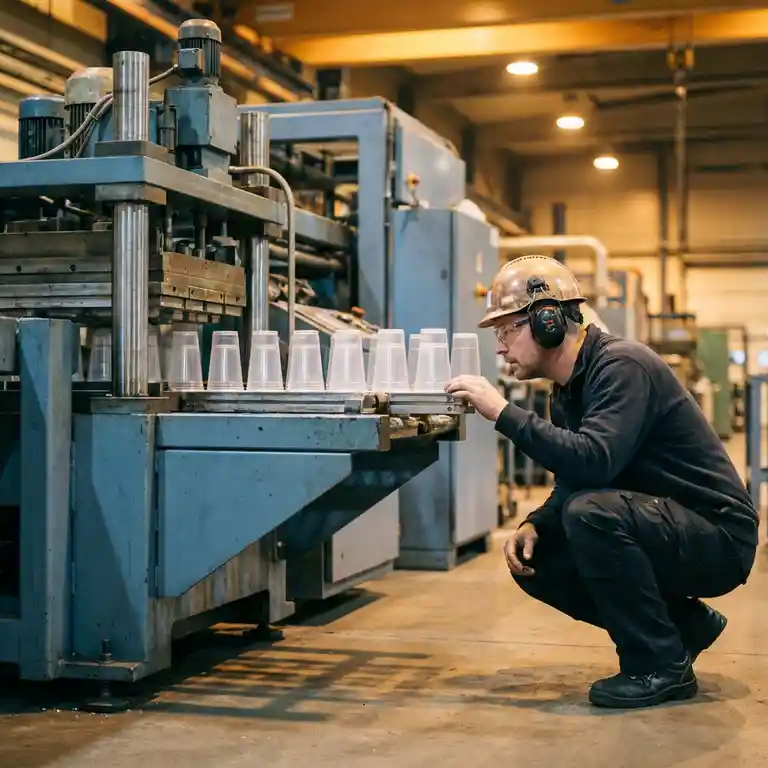
Walk up to a pressure former during a run and you can hear the air system before you see it. A heavy thump as the clamp frame closes, a hiss as the plug comes down, then the big whoosh when the forming box fills and the sheet slams into the tool. Do that eight or ten times a minute, all shift, and the compressor room has opinions about it.
Thermoformers tend to treat air as a utility they inherit with the building. Then they add a second machine, the pressure drops, and parts start coming out thin in the corners. This is how we would think about compressed air for thermoforming, from the forming box back to the compressor.
Where a thermoformer actually uses air
Thermoforming heats a plastic sheet until it is soft, then pulls or pushes it against a tool. Vacuum does the pulling. That is limited by the atmosphere: a vacuum former has about 14.7 psi of atmospheric pressure to work with, and no more. Pressure forming adds compressed air on the back side of the sheet. Industry sources put typical pressure forming air at roughly 20 to 60 psi, and some specialty processes run higher. One solid-phase polypropylene process, for example, is described as using around 100 psi. The point is that pressure forming gets you sharper detail and more definition than vacuum alone.
Air shows up in several other places on the same machine.
- Forming box and pressure cap. The big intermittent draw.
- Plug assist. Plug assists pre-stretch the sheet before it contacts the mold, and many are driven pneumatically.
- Clamp frames and sheet handling. Cylinders that open, close and index.
- Trim presses, punches and ejection. Short, hard strokes.
- Blow-off and part cooling. Air jets that cool the part or clear debris and scrap.
- Stacking and packaging. Often the last stage and the most overlooked.
The load is a burst, not a flow
This is the single most useful thing to understand about a forming line. The air demand looks nothing like a steady 100 SCFM. It looks like a handful of quick, large gulps per minute. If you size only for the average, the compressor will keep up on paper and starve the forming box in practice.
You can work out the gulp yourself. Free air used equals the volume being filled times the absolute pressure ratio. Here is an example using assumed numbers, not a spec for any particular machine.
| Item | Assumed value |
|---|---|
| Forming box volume | 6 cubic feet |
| Forming pressure | 50 psi |
| Free air per cycle | 6 x (50 + 14.7) / 14.7 = about 26 SCF |
| Cycles per minute | 8 |
| Average demand from forming air | about 211 SCFM |
That is only the forming air. The clamps, plug and trim add to it. Your machine builder can give you the box volume and a recommended supply pressure and flow, and you should ask for them in writing before you buy a compressor.
Notice what the table does not say. It does not say the compressor has to deliver those 26 SCF in the second the box fills. Storage covers that. This is where most plants lose money.
Storage and flow control do the heavy lifting
A receiver close to the forming machine lets a modest compressor feed a violent load. The receiver holds the gulp, the compressor refills it between cycles, and the plant pressure never notices. If you skip the receiver, the machine pulls from the whole plant header, and every other machine on that header sees the dip.
We would put a dedicated receiver at each forming machine, sized to hold several cycles' worth of free air with a small drop in pressure. Browse our air compressor tanks for sizes from small vertical units up to large horizontal ones. On the plant side, a pressure flow controller sits between the compressors and the distribution header and holds header pressure steady while the receiver absorbs the burst. It lets you run the compressor at a lower, cheaper pressure while the machine still sees what it needs.
Which compressor
Forming lines run long shifts, often multiple shifts, so a rotary screw is the usual answer. Load/unload control with generous storage works well when the load is a few big gulps. If the plant has widely varying shifts or several machines, a variable speed drive can follow demand more closely. Our rotary screw air compressors cover the range, and the right size depends on your total demand, plus a margin for the second machine you will add in two years.
A few plants, mostly small shops running one pressure former, can get away with a large two-stage piston compressor and a big tank. That works if the duty cycle is honest and you keep the cooling and maintenance up.
Air quality: what the sheet and the product will tolerate
Plain thermoforming air does not have to be as clean as air for a pharmaceutical line. But it does touch the sheet, and a few specific things hurt.
- Water. Droplets in the forming air can mark the surface of the sheet, and in a cold shop the exhaust can ice up. A refrigerated dryer is the usual starting point. See our air dryers.
- Oil. Oil carryover can leave a film on the sheet, which hurts printing, decorating or later bonding. A coalescing filter after the dryer takes care of most of it.
- Particulate and rust. Scale from old iron pipe ends up in the forming box and on the part.
As a working target, ISO 8573-1 Class 2:4:2 (particles, water, oil in that order) is a sensible place to start for general forming air. That means a pressure dew point of about 38 degrees Fahrenheit and a low oil level. If your parts are food packaging and the air contacts the product side, or your customer audits you under a packaging standard like BRCGS Packaging Materials or SQF, ask what they expect for compressed air and consider a tighter target such as Class 1:2:1 with oil-free air. That is a decision for your quality team and your customer, not something we can make for you.
For filters, start with coalescing air filters sized for the full flow, and put them where they protect the machine instead of the compressor room.
The mistakes thermoformers make
- Sizing to average CFM. The forming box is a burst load. Size to the peak and the storage.
- No local receiver. The machine borrows from everyone else on the header.
- One regulator for the whole machine. Forming air, plug and clamps do not all want the same pressure. Branch and regulate separately.
- Undersized hose and fittings at the machine. A restriction in the last few feet starves the forming box no matter what is upstream.
- Ignoring trim and stack air. The last stage is often forgotten in the load calculation.
What we do and do not sell
We sell compressors, receivers, dryers, filters, drains and the controls around them. We do not sell thermoforming machines, heaters, tooling or plug assists. If your forming machine specifies a pressure and flow, we can help you build the air supply to meet it.
Frequently Asked Questions
How much compressed air does a thermoforming machine use?
It varies by machine, box volume, forming pressure and cycle rate. Multiply the box volume by the absolute pressure ratio to find free air per cycle, then multiply by cycles per minute. Get the box volume and recommended supply from the machine builder.
What air pressure does pressure forming need?
Industry sources put typical pressure forming at about 20 to 60 psi, with some specialty processes running higher. Your machine and material determine the real number, so follow the builder's specification.
Do I need an air dryer for thermoforming?
Usually yes. Water in the forming air can mark the sheet and can ice up exhausts in a cold shop. A refrigerated dryer is the common choice, and a desiccant dryer is worth considering for colder or more sensitive work.
Should each thermoforming machine have its own receiver?
It is a good idea. A local receiver holds the burst of air for each cycle, so the plant header pressure stays steady and other machines are not starved.
What compressor suits a thermoforming plant?
Most plants running several shifts use a rotary screw compressor with plenty of storage. A variable speed unit can help where demand swings a lot. A very small shop with one machine may manage with a large two-stage piston unit.
Ready to Shop
Start with the compressor, then add storage, a dryer and filters that match your forming machine's spec. Our rotary screw air compressors are the usual first stop for a forming line.


