


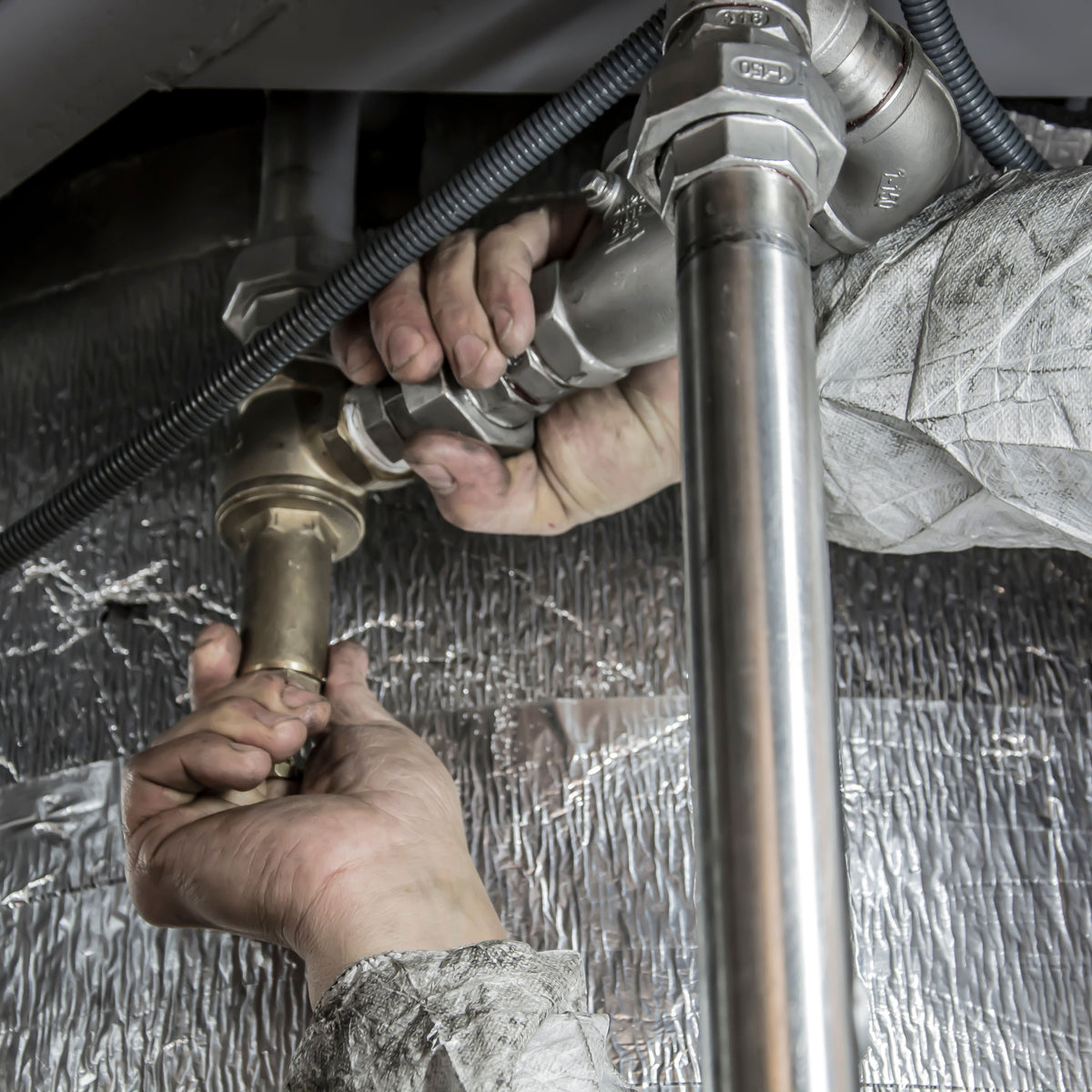
The rough-in inspector is on his way and you are standing in a framed basement with a capped stack, a test gauge and a compressor on a 50 foot cord. The question is not whether the pipe will hold. The question is whether you are about to put more pressure on it than it was ever meant to see.
That is the center of compressed air for plumbing contractors. The work itself is low volume. A plumber rarely needs big CFM. What a plumber needs is a compressor that is easy to carry, a regulator that actually controls pressure, and a clear idea of where air is allowed and where it is not.
Where a Plumber Uses Compressed Air
Most plumbing crews end up using air in four ways.
- Air testing drain, waste and vent (DWV) systems on jobs where the local code allows it.
- Blowing out lines for winterizing seasonal homes, hose bibs, and irrigation or fire-suppression stubs.
- Clearing blockages and flushing with air-powered tools and attachments.
- Running air tools such as hammer drills, chisels for notching, and impact wrenches on larger mechanical work.
Each of these asks something different of the compressor, so the right machine depends on the mix of work you do. The first one is the one that gets people into trouble, so we will start there.
Air Testing a DWV System: What the Code Says
The International Plumbing Code (IPC) covers air testing in Section 312. For drainage and vent systems made of materials other than plastic, the test is a minimum of 5 PSI held for not less than 15 minutes. Because that pressure is under 10 PSI, the code requires a gauge that reads in increments of 0.10 PSI or less. A gauge from the bottom of the compressor toolbox will not read that finely. You need a purpose-built test gauge, usually available from a plumbing supply house.
The part many crews do not know is the plastic rule. According to ICC guidance, the IPC prohibits testing plastic pipe, tubing and fittings with air pressure, because of the risk of the pipe bursting and shattering. Plastic pipe manufacturers prohibit it as well. The same guidance points out that over-pressurizing is a real risk wherever pumps and compressors are used, even at a 5 PSI test level. Five PSI is not much, but a compressor with no regulator will happily make 125.
Codes vary by state and jurisdiction, and your local inspector has the final word. Check what is allowed on your jobs before you plug anything in. We are not a code authority and this is not a substitute for your adopted plumbing code.
Putting a Safe Test Rig Together
Whatever your local rules are, the set-up logic is the same. Never connect a compressor directly to the system under test. Put a regulator between them, set it low, and watch the test gauge, not the regulator dial. Add a relief valve set above your test pressure and below the pipe's limit. Fill slowly. And keep people away from the system while it is under pressure.
A regulator rated for the low end matters here. Our regulators are the place to look, and the air compressor regulator guide explains how to set one.
How Much Air Does a Test Take?
Very little. Take 100 feet of 4 inch drain line. The inside area is about 0.087 square feet, so the line holds roughly 8.7 cubic feet. To add 5 PSI above atmospheric, you need to add about 8.7 times 5 divided by 14.7, which is about 3 cubic feet of free air. Even a small portable compressor does that in well under a minute. What you are buying is control, not capacity. If you want to dig into the math behind this, our article on air compressor pump-up time shows the same formula.
Blowing Out Lines
Winterizing is the other big use. You blow water out of supply lines, hose bibs and irrigation stubs so nothing freezes and splits over the winter. Here the flow matters more than it does on a test, because you are moving water out of long runs and pushing it through valves and fixtures.
The risks are different too. Blowing out a line under high pressure can damage fixtures, shatter plastic fittings and send water and debris out the open end at speed. Keep pressure low, open fixtures one at a time, and wear eye protection. If a line serves anything with a pressure rating lower than your regulator setting, isolate it first.
Choosing the Compressor
Most plumbing contractors do well with a portable machine. It rides in a truck or van, plugs into a 120 volt outlet, and has a tank big enough to smooth out the cycling. Look at our portable air compressors, and read our portable compressor buyer's guide for the sizing logic.
| Use | What matters | Typical fit |
|---|---|---|
| DWV air test | Regulated low pressure, any size compressor | Small portable with a good regulator |
| Line blowout | Steady flow at modest pressure, dry output helps | Mid-size portable with a larger tank |
| Air tools on mechanical work | CFM at 90 PSI for the tool in use | Larger portable or shop compressor |
If you use air tools on bigger mechanical jobs, add up the CFM for the tools you actually run at the same time, not every tool in the truck. Our air compressor diversity factor article explains why adding up every tool buys too much compressor. Make sure you are comparing like with like on ratings by reading SCFM vs CFM before you buy.
Hose and Fittings
Use a hose rated above what the compressor can make, with proper quick couplers. A short whip hose at the test point and a longer supply hose from the compressor is a handy split. Our hoses and quick couplers are sorted by size so you can match the fittings on your test manifold.
Water in the Air
A plumber is the last person who wants water in the airline, and yet portable compressors produce condensate. Drain the tank at the end of each day. If you are blowing out lines for a customer, an inline water separator keeps your own tank condensate from adding to the problem. The water separators collection has compact options.
What We Do and Do Not Sell
We sell the compressor, regulator, hose, coupler and water removal side of this. We do not sell plumbing test gauges, test plugs or pressure test kits. Those come from your plumbing supply house, and you should buy the gauge that your inspector will accept.
Mistakes We See
- Air testing plastic pipe. The IPC prohibits it. Use water.
- No regulator between compressor and system. A tank full of 125 PSI air will find the weakest joint.
- Using the wrong gauge. Under 10 PSI the code wants 0.10 PSI increments.
- Blowing out lines at full tank pressure. Lower is safer for fixtures and for you.
- Buying too much compressor. Testing and blowouts are low volume. Buy portability and control first.
Frequently Asked Questions
Can I air test plumbing pipe?
It depends on the pipe and your local code. The IPC allows an air test of DWV systems made of non-plastic materials at a minimum of 5 PSI for at least 15 minutes, and it prohibits air testing of plastic pipe, tubing and fittings. Check with your local inspector before you test.
What gauge do I need for a 5 PSI air test?
Because the pressure is under 10 PSI, the IPC calls for a gauge with increments of 0.10 PSI or less. A normal compressor gauge is not accurate enough.
What size compressor do I need to test a drain line?
A small one. A 100 foot run of 4 inch pipe needs only about 3 cubic feet of free air to reach 5 PSI. The key is a regulator and relief valve so you do not over-pressurize the pipe.
Is it safe to blow out water lines with a compressor?
It can be, if you keep pressure low, open one fixture at a time and isolate anything with a lower pressure rating. Wear eye protection because water and debris can leave the line at speed.
Do I need an air dryer on a plumbing truck compressor?
Usually not a dryer, but a water separator and a daily tank drain are worth having, especially for blowouts.
Where to Start
For compressed air for plumbing contractors, pick a portable compressor you can carry, put a real regulator and relief valve between it and the work, and buy the proper test gauge from your supply house. Browse our portable air compressors and call us if you want help matching one to your truck.


