


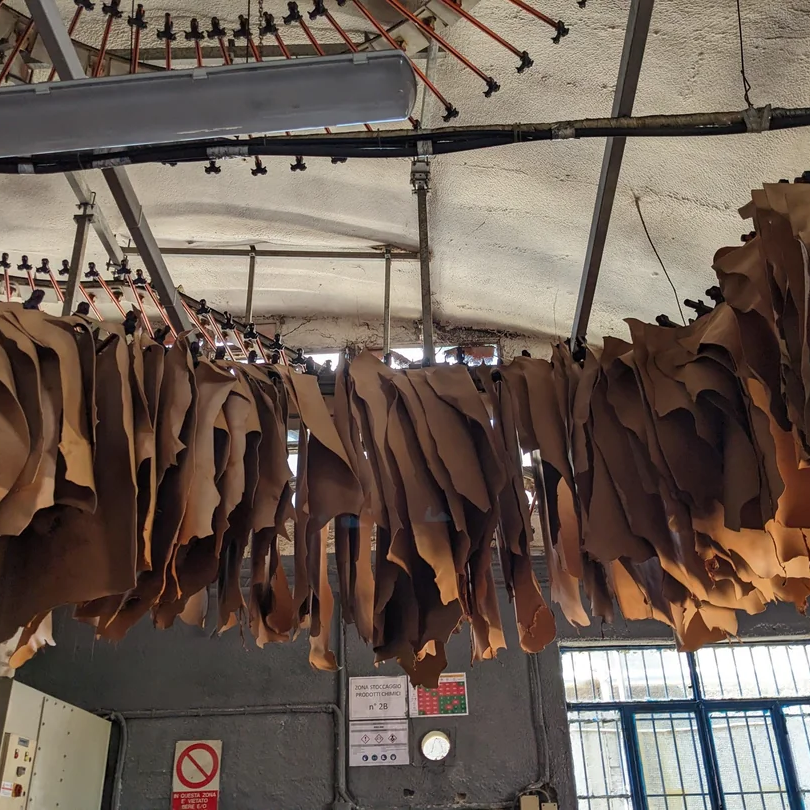
Walk through a tannery and you learn quickly that nothing about it is dry. Hides come in salted and stiff, go into drums that smell like lime and sulfide, come out soft and wet, get split, shaved, set out, dried, buffed and sprayed. Water runs on the floor from one end of the building to the other. And somewhere in a corner there is a compressor room that every department leans on without thinking about it.
That is the setup for compressed air for tanneries. It is a wet, corrosive, dusty trade that still needs clean, dry air in the finishing room. If you run a tannery or a leather goods plant with in-house finishing, here is how the air side usually breaks down, what the process puts on your compressor, and where we can and cannot help.
Where a tannery uses compressed air
The EPA's process description for leather tanning lays out the sequence: beamhouse (trimming, soaking, washing, fleshing and unhairing), tanyard (bating, pickling, tanning, wringing and splitting), and post-tanning (setting out, drying, conditioning, staking, dry milling, buffing and finishing). Chrome tanning accounts for about 90 percent of U.S. production, with vegetable tanning used mainly for heavy and sole leather. Air shows up at nearly every stage, but the demands are very different.
| Area | What air typically does | What matters most |
|---|---|---|
| Beamhouse and tanyard | Drives air-operated diaphragm pumps for chemical and wastewater transfer, operates pneumatic valves and drum controls | Reliability in a wet, corrosive room |
| Wet finishing and setting out | Pneumatic clamping and tool air on the line | Steady pressure, dry air |
| Drying (toggling, pasting, vacuum) | Controls, actuators, tool air | Clean dry air for instruments |
| Buffing and dry milling | Pulse-jet dust collection, air tools | Strong cleaning pulses, dry air for the collector |
| Spray finishing | Atomizes coatings, dyes, resins and lacquers | Oil-free, water-free air at the gun |
The pneumatic details vary from plant to plant. A big plant with a staking line and a drum house has a different air profile than a small shop making vegetable tanned belt leather. The point of the table is that the wet end wants rugged, and the finishing end wants clean.
The finishing room is the picky one
Finishing is where a bad compressed air system shows up on the product. The EPA lists coatings made from waxes, shellac, pigments, dyes and resins, plus urethane lacquer for a glossy patent finish. Water-based and solvent-based finishes are both in use, and the agency notes that many tanneries have moved to water-based coatings to cut VOC emissions.
Any of those, sprayed through an atomizing gun, will tell you right away if your air carries water or oil. Fisheyes, spitting, blotchy color and poor adhesion are the usual symptoms. A good target for a finishing line is air that meets ISO 8573-1 oil class 1 or 2 and a pressure dew point well below the coldest temperature the lines will see. We cover the classes in our guide to ISO 8573-1 compressed air quality classes.
In practice that means a coalescing filter ahead of the finishing booth, a dryer upstream, and a point-of-use filter and regulator at the spray station. Do not try to correct a wet main with a single filter at the gun.
Dust, chromium and the buffing room
Buffing uses fine abrasives to produce suede and nap finishes, and it throws off a lot of fine dust. The EPA notes that buffing, shaving and drying release particulates, and that buffing dust may contain chromium. Dust collectors and scrubbers are the standard controls.
Many collectors on these lines are pulse-jet units, which clean their filter media with short bursts of compressed air. If that air is wet, the dust cakes on the bags and the pulses stop doing their job. That is a common reason for a collector that loses differential pressure control after a humid week. Our refrigerated air dryers are a good place to start for the dryer side, and a pulse-jet collector wants consistent pressure, so keep the line to it full size.
If your dust has regulated metal content, your safety and environmental people own that question. We sell compressors, dryers and filters, not dust monitoring or exposure programs.
Drying lines have their own air quirks
A leather plant dries hides several ways. Horween describes air drying on hooks (with a typical shrink of about 25 percent), toggling, pasting hides onto plates and running them through a multi-zone unit for about five hours, and vacuum drying. The EPA also lists high-frequency drying. Most of the drying energy is steam, heat and vacuum, not compressed air. Where compressed air comes in is on the controls, the actuators, and the pneumatic tools around the line. Instrument air on a dryer line should be clean and dry. A drifting damper actuator because of water in the line will wreck a batch faster than almost anything.
The environment will eat your equipment
Here is the part most generic compressor advice skips. The EPA notes ammonia from deliming, unhairing and drying, plus sulfides and hydrogen sulfide from liming and unhairing, with H2S gas forming from alkaline sulfides if wastewater pH drops below 8.0. Those gases are hard on metal and on compressor intake air.
- Put the compressor room intake in clean air. Do not draw from the beamhouse or any area that smells of sulfide or ammonia.
- Keep the compressor room clean and cool. Dust from buffing and heat from drying equipment both shorten the life of a compressor.
- Be careful what you run through the wet end. We sell aluminum pipe, and it is a great choice for most plants. In a corrosive beamhouse atmosphere, ask us first. We would rather help you route clean, dry air in than sell you pipe that pits.
- Drain and filter at every drop. Water in the line is the one thing a tannery has in unlimited supply.
Sizing a tannery air system
We are not going to hand you a CFM figure for a plant we have not seen. Tanneries range from small shops to large operations, and the process mix drives demand. Here is how to get a real number:
- List every pneumatic consumer by department: diaphragm pumps, valves, spray guns, tools, dust collector pulse valves.
- Get the CFM and operating pressure for each from the nameplate or manual.
- Multiply by the fraction of the time each runs, then add them up.
- Add allowance for leaks, which commonly eat a large share of a plant's air, and for growth.
- Size the compressor, receiver and dryer to that number, with a backup unit if finishing is critical.
For most plants with steady, multi-shift demand, a rotary screw compressor is the right primary machine, because it is built for continuous duty. Pair it with a dryer sized for the full flow, a coalescing filter bank, and a receiver. A smaller trim unit or variable speed machine handles the weekends and off shifts. Browse the rotary screw air compressors and coalescing air filters we stock.
What we can and cannot do for a tannery
We sell the air system: compressors, dryers, filters, drains, receivers, piping and air tools. We do not sell hide processing machinery, spray finishing machines, dust collectors, or wastewater equipment, and we cannot design your process. If you are specifying a new finishing line, we can help you get the air right.
Chemical handling and waste rules sit with your environmental and safety staff. We keep our advice to the compressed air side.
Mistakes tanneries make with compressed air
- One filter at the gun. Fix the main, then polish at the point of use.
- Intake near the beamhouse. Corrosive air in, short compressor life out.
- Manual drains left to the shift. They get skipped. Use automatic drains.
- Wet air to the dust collector. It cakes the bags and the pulses stop working.
- No backup. A finishing line down for a compressor failure is expensive.
- Ignoring leaks. A damp, noisy plant hides them well. An ultrasonic detector finds them.
Frequently Asked Questions
What air quality does a tannery finishing room need?
Spray finishing wants oil-free, water-free air at the gun. A good target is ISO 8573-1 oil class 1 or 2 and a pressure dew point below your coldest line temperature, with a point-of-use filter at each spray station.
Does a tannery need a rotary screw compressor?
Most plants running multiple shifts do. Rotary screws are built for continuous duty, which suits steady demand from pumps, controls, collectors and finishing.
Can I use aluminum air pipe in a tannery?
Often yes, but not blindly. Ammonia and sulfide atmospheres in the beamhouse are hard on metals, so ask us before routing pipe through the wet end.
Why does my dust collector stop cleaning properly?
Wet pulse air is a common cause. Moisture makes dust cake on the filter media. Check your dryer and drains first.
Where should the compressor intake go?
Draw air from a clean, cool, dry area, away from the beamhouse, drying exhaust and buffing dust.


