


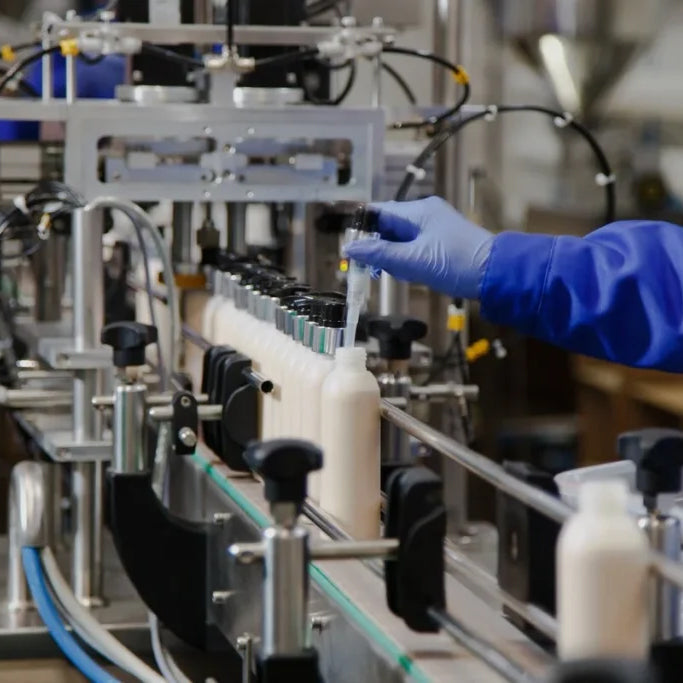
A contract manufacturer filling a facial serum had a run come back from a retailer over particulate in the bottle. They tore apart the filler, the capper and the bottle supplier. Three weeks later somebody put a filter housing on the blow-off line that cleans the bottle before it indexes under the nozzle, cut it open, and found exactly what was ending up in the product. The air that was supposed to clean the container was the thing contaminating it.
That is the shape of the risk with compressed air for cosmetics manufacturing. Very little of your air touches product on purpose, but the places it does touch product are the last step before a sealed container, so there is nothing downstream to catch a mistake.
The Regulatory Situation, Stated Accurately
This is worth getting right, because there is a lot of loose talk in this industry right now.
The Modernization of Cosmetics Regulation Act brought cosmetics under meaningfully more FDA oversight. Facility registration and product listing are in effect and enforceable, with registrations renewed every two years. Good manufacturing practice is the part that has not landed. FDA was directed to issue GMP regulations, the proposed rule missed its statutory deadline, and the rulemaking has been reclassified as a longer term action. As of now there is no final cosmetic GMP regulation.
What that means practically for your air system:
- No rule currently tells you what class of compressed air to use. Anyone who says MoCRA requires a specific ISO class is ahead of the regulation.
- You are still expected to demonstrate control. FDA already expects structured manufacturing controls and documented safety substantiation, and your retail customers' audits are frequently stricter than any government rule.
- Writing your own spec now is the cheap move. Picking a standard, documenting it and testing against it costs very little today and puts you ahead of whatever the GMP rule eventually says.
Most plants that do this well borrow the food industry's framework, because it is mature and auditors recognize it. That means treating any air that contacts product or product contact surfaces as food grade air, and leaving everything else at general industrial quality. Our ISO 8573-1 explainer and the food grade compressed air piece are the two to read.
Where Air Touches Product, and Where It Does Not
| Use | Touches product? | Sensible target |
|---|---|---|
| Container blow-off before filling | Yes, directly | Dried, coalesced and carbon filtered, roughly ISO Class 1.2.1 |
| Filler and capper actuation | No, but it is inches away | Class 1.4.1, no oil carryover into the room |
| Tank and vessel blanketing or transfer | Yes | Same as blow-off, treat as product contact |
| Powder handling, talc and mica conveying | Yes | Dry above all. Moisture clumps powder. |
| Labeler, case packer, palletizer | No | General industrial, Class 1.4.2 |
| Compounding room agitation and dosing pumps | Indirect | Clean, dry, reliable |
| Shop and maintenance | No | General industrial |
Note the structure. Filter the whole plant to a sane general class and then add point of use treatment at the handful of drops that reach product. Treating every CFM in the building to blow-off quality means paying a pressure drop penalty forever to protect ten percent of your air.
Oil Free or Lubricated, Honestly
You will get a hard sell on oil-free in this industry. Here is the straight version.
A lubricated rotary screw with correct coalescing filtration plus an activated carbon stage produces air that genuinely meets a very low oil content, and plenty of food and personal care plants run exactly that way without issue. It is less money up front and the machines are proven.
An oil-free compressor removes a category of risk rather than filtering it. In a plant where a single contaminated lot means a retailer recall and a brand conversation, that reads differently on a risk assessment and it is noticeably easier to defend in an audit. It is also simpler: no separator to monitor, no carbon bed to change on schedule, no argument about whether the filtration was maintained.
Our honest guidance: if you are a contract manufacturer filling for brands that audit you, oil-free on the product contact side is worth the premium for the audit position alone. If you are filling your own line into your own channel and you maintain filtration properly, lubricated with a proper treatment train is defensible. What is not defensible is lubricated with no carbon stage and no filter change records.
One thing oil-free does not do: it does not make water. It still pulls in whatever humidity and whatever room contaminants are present. You still need the dryer and the filters. Browse air filters for the coalescing and carbon stages either path requires.
The Powder Problem
Color cosmetics plants have an issue that skincare plants do not: fine powder. Talc, mica, pigments, pressed powder lines. Two consequences for your air system.
First, dryness stops being about corrosion and starts being about the product. Moisture in conveying or fluidizing air clumps powder, and clumped powder is a rejected pressing. The dew point target in a powder area should sit comfortably below anything the line will see, which usually means a refrigerated dryer at minimum and desiccant if any line runs cold or outdoors. Read refrigerated vs desiccant.
Second, the airborne powder is hard on the compressor itself. Do not let the machine breathe the production room. Duct the intake to clean outside air or put the compressor in a separate mechanical space. An intake element in a powder room loads fast, and what gets past it goes into the airend.
Aerosols and Flammable Fills
If you fill aerosols, or handle alcohol-based fragrance and sanitizer in volume, parts of your plant are likely classified areas and the room classification is determined by your engineer and your fire marshal, not by an equipment vendor.
Where compressed air helps: inside a classified space, pneumatic drives have no electrical ignition source, which is why air motors and air-operated diaphragm pumps show up on transfer and agitation duty in flammable fill rooms. That is a genuine advantage, and it is not a compliance shortcut. Bonding and grounding still apply, exhaust routing still matters, and the installation still gets approved by your authority having jurisdiction. More on the trade-off in air motors: when air beats an electric motor.
Separately: aerosol propellant charging is its own equipment category with its own pressure requirements, and it is usually a gassing house package rather than something fed from plant air. Size your plant air for everything around it, not for the gasser.
What we do not sell, plainly
We sell compressors, dryers, filtration, receivers, piping, air motors and nitrogen generators. We do not sell fillers, cappers, gassing houses, cleanroom HVAC, or the gas detection and ventilation packages a classified fill room needs, and we do not write your GMP documentation. We can spec the air side and tell you where our scope ends.
Testing, Because a Spec You Cannot Prove Is Not a Spec
The thing that turns a good intention into an audit answer is a test record. Sample at the point of use, not at the compressor, because the pipe between them is part of the system. Test for the three things the standard measures: particles, water and oil. Annual is a reasonable baseline for most personal care plants, more often if you had a deviation or changed the system.
Add continuous dew point monitoring on the product contact header if you can. A panel light that says the dryer is running is not the same as a number that says what the dew point actually is, and the number is what an auditor wants to see trended.
Mistakes This Industry Makes
- Assuming MoCRA set an air spec. It did not. Your retail customers' audits probably will before FDA does.
- Treating the whole plant to blow-off quality. You pay pressure drop on every CFM to protect a few drops. Use point of use treatment instead.
- Forgetting the blow-off line entirely. It is the single most direct path from your air system into a sealed container.
- Compressor breathing the powder room. Fast intake loading, grit in the airend, and a cooler that blinds.
- Buying oil-free and skipping the dryer. Oil-free still makes water.
- Testing at the compressor. The contamination you care about is often picked up in the pipe.
- No filter change records. On the lubricated path, the records are the argument. Without them you cannot claim the air quality you say you have.
Frequently Asked Questions
Does MoCRA require a specific compressed air quality?
No. Facility registration and product listing are in effect and enforceable, but FDA has not issued a final cosmetic GMP regulation, and the rulemaking has been pushed to a longer term action. No current rule names a compressed air class. You choose and document a standard, and most plants borrow the food framework because auditors recognize it.
Do I need an oil-free compressor for cosmetics?
Not strictly. A lubricated rotary screw with proper coalescing and activated carbon filtration meets a very low oil content and is used widely in personal care. Oil-free removes the risk rather than filtering it, which is easier to defend in a customer audit and simpler to maintain. If you are a contract manufacturer being audited by brands, oil-free on the product contact side is usually worth the premium.
What air quality should I target for blow-off before filling?
Treat it as the most critical air in the plant, because it is the last thing to touch the container before it is sealed. Something in the neighborhood of ISO 8573-1 Class 1.2.1 at that drop, achieved with drying plus coalescing plus activated carbon at the point of use, is a sensible and defensible target.
How often should I test compressed air quality?
Annually as a baseline for most personal care plants, sampled at the point of use rather than at the compressor, testing particles, water and oil. Test more often after a system change or a deviation, and trend continuous dew point on the product contact header if you can, because a trended number is far stronger evidence than a dryer status light.
Does powder handling change my dryer requirement?
Yes. In color cosmetics, moisture clumps talc, mica and pigments, so dryness becomes a product quality issue rather than just a corrosion issue. Hold the dew point comfortably below anything the line sees, which generally means refrigerated drying at minimum and desiccant if any line runs cold or passes through an unconditioned space.
Where to Start
Find every place air touches product or a product contact surface and write them down. In most plants that list is shorter than people expect and it is almost always missing the blow-off line. Treat those drops properly, leave the rest of the plant at a sane general class, and get a test record on file. Getting compressed air for cosmetics manufacturing right is mostly about knowing which few drops actually matter and being able to prove what comes out of them.


