


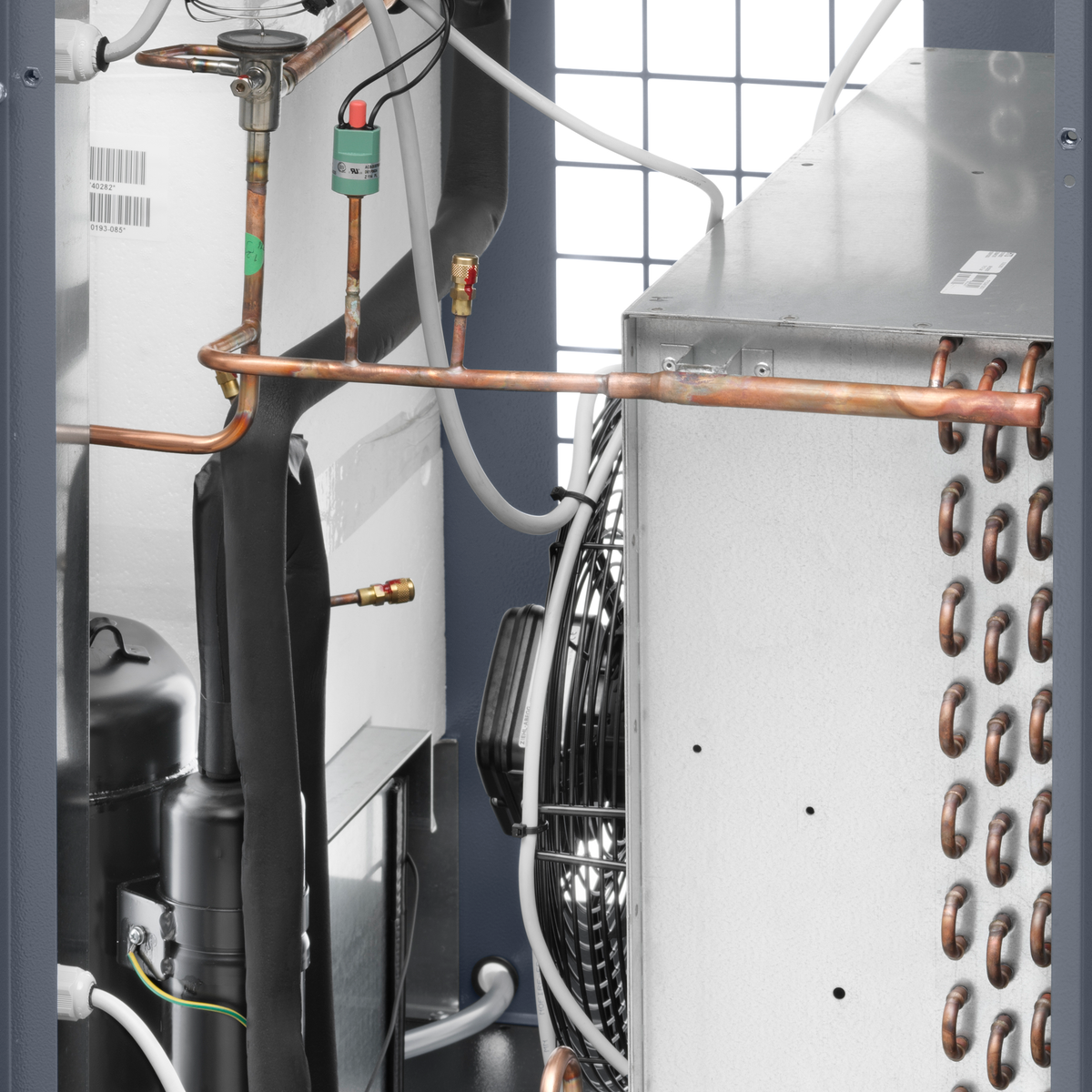
Somebody in maintenance flips the access panel on a ten-year-old refrigerated dryer, reads the nameplate, and says, "What's R-404A? Can we even get that anymore?" It is a fair question, and it is showing up in our inbox more often. The refrigerated air dryer refrigerant inside your dryer is a quiet line item that can turn into a loud one when a compressor fails or a quote comes in for a new unit.
Here is what is actually in these machines, how the refrigerants differ, what the U.S. HFC phasedown does and does not mean for the dryer you already own, and what to look at before you buy the next one.
What the refrigerant does in a compressed air dryer
A refrigerated dryer is a small, purpose-built refrigeration system. It cools compressed air to around 35 to 40 degrees Fahrenheit so water vapor condenses out, then the air is reheated slightly and sent downstream. The refrigerant is the fluid carrying that heat away. If you want the broader picture of when a refrigerated dryer is the right tool, our guide to refrigerated versus desiccant dryers covers it, and the post on cycling versus non-cycling dryers explains the control side.
The refrigerant matters for two reasons. It sets how the dryer performs and how big its compressor is, and it increasingly sets how easy or costly the dryer will be to service.
The refrigerants you will actually see
Across the industry, dryer makers have used a handful of refrigerants. Smaller dryers, roughly 5 to 1,000 cfm, have long used hermetic piston compressors with lower-pressure refrigerants, moving from R-22 to R-134a over the years. Larger dryers above about 1,000 cfm have commonly used semihermetic scroll compressors with medium-pressure refrigerants such as R-404A. The table below pulls the common ones together. The global warming potential (GWP) figures are as published in a trade article on dryer refrigerants, and sources differ slightly on some values.
| Refrigerant | GWP (approx.) | Where it shows up | Notes |
|---|---|---|---|
| R-134a | about 1,300 to 1,430 | Small and mid-size dryers | The long-time workhorse; lower pressure |
| R-410A | 2,088 | Higher-pressure designs, mid-size dryers | Being phased out of new equipment in many places |
| R-404A | 3,922 | Large dryers | Highest GWP of the common set |
| R-513A | 573 | Newer dryers | Safety class A1; highly compatible with R-134a designs |
| R-1234yf / R-1234ze | Low (no figure in our source) | Some newer designs | Can lose capacity or efficiency in a unit designed for R-134a |
| R-290 (propane) | Very low | Niche | Class A3, highly flammable |
One manufacturer, Kaeser, has publicly stated that its refrigerated dryers ship with R-513A. That fits the general direction: dryer makers are moving mid-size units toward lower-GWP refrigerants that behave like R-134a, so the redesign is modest.
What the HFC phasedown actually does
In the U.S., the American Innovation and Manufacturing (AIM) Act directs EPA to cut HFC production and consumption by 85 percent from baseline by 2036. EPA's published step-downs run like this:
- 2020 to 2023: 90 percent of baseline
- 2024 to 2028: 60 percent
- 2029 to 2033: 30 percent
- 2034 to 2035: 20 percent
- 2036 and after: 15 percent
Fewer HFCs entering the market over time tends to push prices up and availability down for the higher-GWP gases like R-404A and R-410A. Separately, EPA's Technology Transitions rule limits what refrigerants may be used in new products and systems made, imported or installed after each subsector's compliance date. Those first dates began on January 1, 2025, and run through January 1, 2028, with a sell-through period. The sector tables change, so check EPA's current list for the category your equipment falls under.
The part that matters if you already own a dryer
EPA says plainly that you can keep repairing existing refrigeration systems, including replacing a major component such as a compressor. The Technology Transitions rule does not restrict equipment already installed. It was designed so owners can use and repair legacy equipment through its useful life. The catch EPA itself notes is that availability of HFCs and some components may shrink over time.
So a ten-year-old R-404A dryer is not a ticking clock. It is a machine whose refrigerant will probably cost more each year to top off.
Does the refrigerant change how well the dryer dries?
A little, and mostly through design, not through the label. The dryer's job is the same: pull the air down to a pressure dew point near 38 degrees F. A well-designed dryer using R-513A holds that just as well as an R-134a unit, because the designers sized the evaporator and compressor for that gas. The trouble comes when someone swaps a refrigerant into a machine that was not designed for it. Lower-GWP options like R-1234yf can lose efficiency in a unit built around R-134a, and some refrigerants reduce capacity at higher pressures. That is why we tell customers not to improvise a refrigerant change on their own. Ask the manufacturer.
What to check on your dryer
- Read the nameplate. It lists the refrigerant type and the charge. Write both down.
- Check the age. A 15-year-old dryer may be on R-22 or R-404A. Those are the ones most likely to get expensive to service.
- Ask who is certified. Have a technician who is properly certified handle refrigerant work. Venting it is not an option.
- Do not top off a leak repeatedly. A dryer that keeps losing charge has a leak, and chasing it with refrigerant gets more expensive as supplies tighten.
- Look at the condenser. A dirty condenser makes the compressor run hot and shortens its life more reliably than any refrigerant choice does.
Buying a new dryer: what to ask
You do not need to become a refrigerant expert. You need three answers from whoever is selling the dryer:
- What refrigerant does it use, and is it a current low-GWP type?
- Is it a cycling (thermal mass) or non-cycling design, and what does that do to power use?
- What is the maximum inlet air temperature and ambient temperature it is rated for?
Browse our full range of air dryers, or go straight to non-cycling refrigerated dryers or high temperature refrigerated dryers if your compressor discharges hot air. Each product page lists the refrigerant where the maker publishes it. If a page does not, ask us before you order and we will check the data plate specifications with the manufacturer.
Frequently Asked Questions
What refrigerant does my air dryer use?
Look at the nameplate on the dryer. It lists the refrigerant type and the charge in ounces or pounds. Older small dryers often use R-134a, and many larger or older ones use R-404A or R-410A. Newer units increasingly use R-513A.
Is R-513A a drop-in replacement for R-134a?
It is highly compatible with R-134a designs, but that does not make it a casual swap. Ask the dryer manufacturer before changing the refrigerant in an existing unit.
Will the HFC phasedown force me to replace my dryer?
No. EPA states you can keep using and repairing existing systems. The pressure is on new equipment and on the long-term price and availability of higher-GWP refrigerants.
Does the refrigerant affect dew point?
Not by itself. A dryer designed for its refrigerant holds the same pressure dew point, typically near 38 degrees F. Problems appear when a refrigerant is swapped into a unit not designed for it.
Can I add refrigerant to my dryer myself?
Use a properly certified refrigeration technician. A dryer that needs frequent top-offs has a leak that should be found and fixed.


