


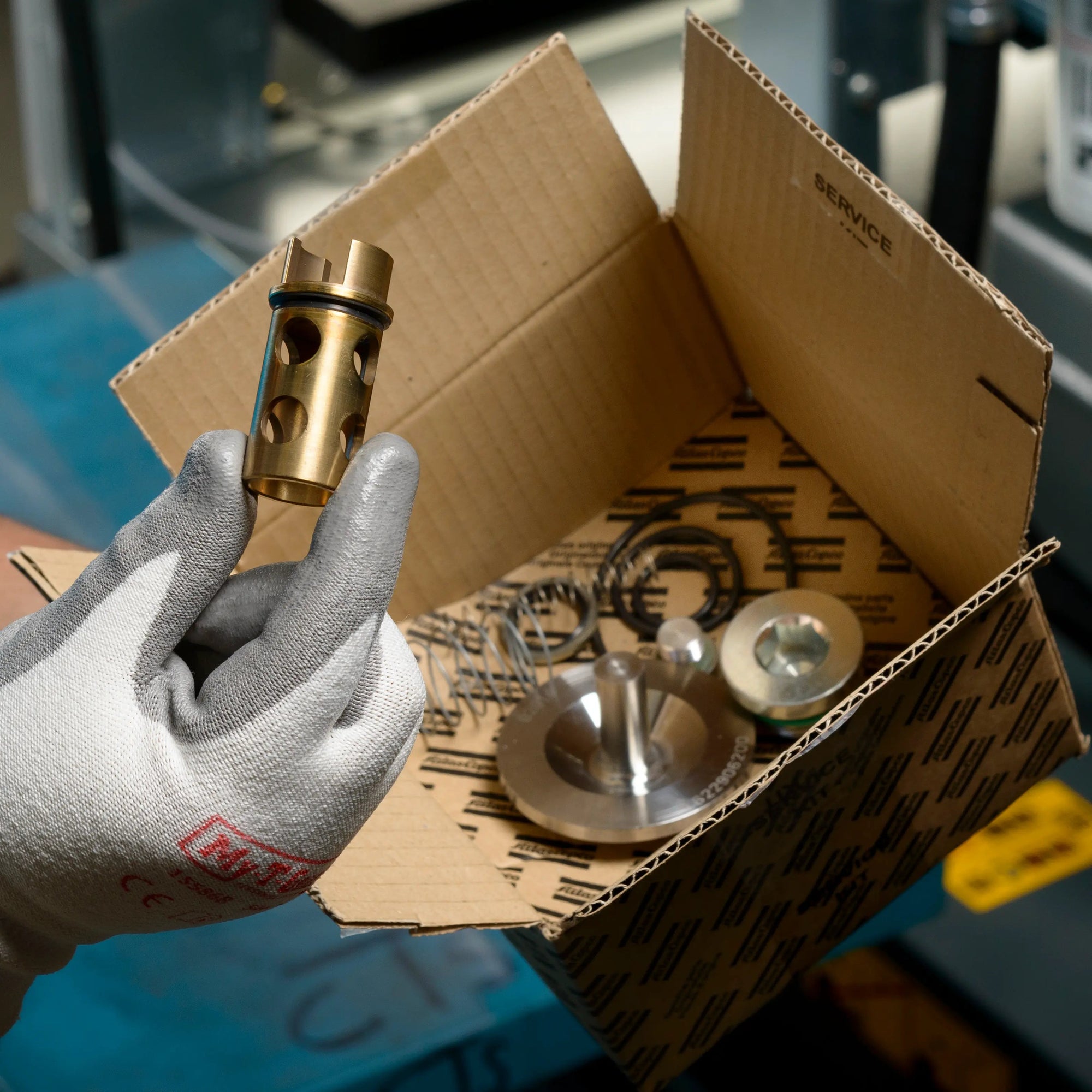
Here's a call we get a lot: "My compressor was fine yesterday, now it hums for a second at startup and trips the breaker." Nine times out of ten the culprit is a ten dollar part most people have never heard of. The air compressor check valve.
It's a small brass fitting, easy to ignore, and it does a job that keeps your whole machine healthy. When it fails, the symptoms look scary and expensive even though the fix usually isn't. Let's walk through what it does, how to spot a bad one, and how to swap it.
What a Check Valve Actually Does
A check valve is a one-way door for air. It sits between the pump and the tank, and it lets compressed air flow in one direction only: from the pump into the tank. When the compressor is running, air pushes the valve open and fills the tank. When the compressor shuts off, the valve snaps closed and traps that air in the tank, so it can't rush back down into the pump.
That backflow prevention matters for two reasons. First, it keeps your stored air in the tank where you want it. Second, and this is the big one, it stops the tank from dumping pressure back onto the pump and motor the next time the compressor tries to start. A motor trying to start against a head full of pressure is a motor that stalls, overheats, and trips a breaker.
The Check Valve and the Unloader Work Together
The check valve doesn't work alone. It has a partner called the unloader valve, and understanding the pair explains most startup problems.
When the compressor reaches its cut-out pressure and shuts off, the check valve closes to hold tank air. At the same time, the unloader valve opens and bleeds off the small amount of air trapped in the line between the pump and the now-closed check valve. That quick hiss you hear a second or two after the compressor stops is the unloader doing its job. It clears the head so the motor gets a fresh, easy start next time.
Here's the tell. If the check valve leaks, tank air sneaks backward past it and out through the unloader. So instead of one short hiss at shutdown, you get a continuous hiss that won't quit, and the motor has to fight tank pressure at the next startup. That's your smoking gun.
Signs Your Check Valve Has Gone Bad
A failing check valve gives you clear warnings if you know what to listen for.
- Continuous air leak from the unloader. If air keeps hissing out of the pressure switch or unloader after the compressor stops, tank air is leaking back past the check valve. This is the classic symptom.
- Hard starting or tripped breakers. When the motor has to start against trapped pressure, it draws heavy current, strains, and can trip the breaker or thermal overload.
- Tank pressure drops fast after shutoff. Watch the tank gauge right after the compressor cuts out. A quick drop means air is escaping back through the valve rather than staying stored.
- Air blowing back out of the pump intake. In a bad case you can feel or hear air puffing out of the intake filter when the unit stops. That's tank air taking the wrong path home.
One quick note. A little hiss for a second or two right at shutdown is normal, that's the unloader clearing the line. It's the constant, ongoing leak that points to a bad check valve.
How to Replace a Check Valve
This is a very doable job for most owners. Take your time and respect the pressure.
Step 1: Drain all the air
Turn the compressor off, unplug it, and open the tank drain until the gauge reads zero. Do not skip this. Working on a pressurized tank is dangerous.
Step 2: Find the valve
The check valve threads into the tank, usually where the discharge tube from the pump meets the tank and near the pressure switch. There's typically a metal tube on one side and the unloader line running to the pressure switch.
Step 3: Remove and inspect
Disconnect the lines and unthread the old valve. Look inside. You'll often find carbon buildup, gunk, or a spring and disc that no longer seat. Sometimes a good cleaning brings it back, but for a part this cheap, replacing it is the smart move.
Step 4: Install the new one
Wrap the threads with PTFE tape, thread the new valve in the same orientation as the old one (they're directional, so note which way the arrow or flow points), and reconnect the lines. Snug, don't gorilla it. Then power up and listen. The nonstop hiss should be gone.
How Long Do They Last?
There's no set lifespan. Check valves fail from heat, carbon buildup from compressor oil, and simple wear on the internal spring and seat. Shops that run hot and hard go through them faster. The good news is they're inexpensive, so keeping a spare on the shelf means a five minute fix instead of a day of downtime. If you're already in there, it's worth glancing at your pressure switch and unloader too, since they live right next door and age together.
Frequently Asked Questions
How do I know if my air compressor check valve is bad?
The clearest sign is a continuous hiss of air from the unloader or pressure switch after the compressor shuts off, instead of one short burst. You may also see tank pressure drop quickly at shutoff and the motor struggle or trip the breaker on the next start.
Can I clean a check valve instead of replacing it?
Sometimes. Carbon and debris can hold the valve open, and a careful cleaning may restore it. But check valves are cheap, and a worn spring or seat won't clean back to new, so most people just replace it and keep a spare.
Why does my compressor trip the breaker on startup?
A common cause is a leaking check valve letting tank pressure sit on the pump head. The motor then has to start against that pressure, drawing high current and tripping the breaker or overload. Replacing the check valve usually cures it.
Is the check valve the same as the unloader valve?
No, but they work as a team. The check valve holds air in the tank, and the unloader bleeds the line between the pump and check valve so the motor gets an easy start. A failure in either one shows up as a startup or leaking problem.
Which way does a check valve go?
Check valves are directional. Air must flow from the pump into the tank, so install the new valve the same way the old one came out and follow any arrow marked on the body. Backwards, it won't let air into the tank at all.
A bad check valve looks like a major failure and fixes like a minor one. Listen for that telltale hiss, drain the tank, and swap the part. If yours is acting up, browse our check valves to find the right replacement and grab a spare while you're at it.


