


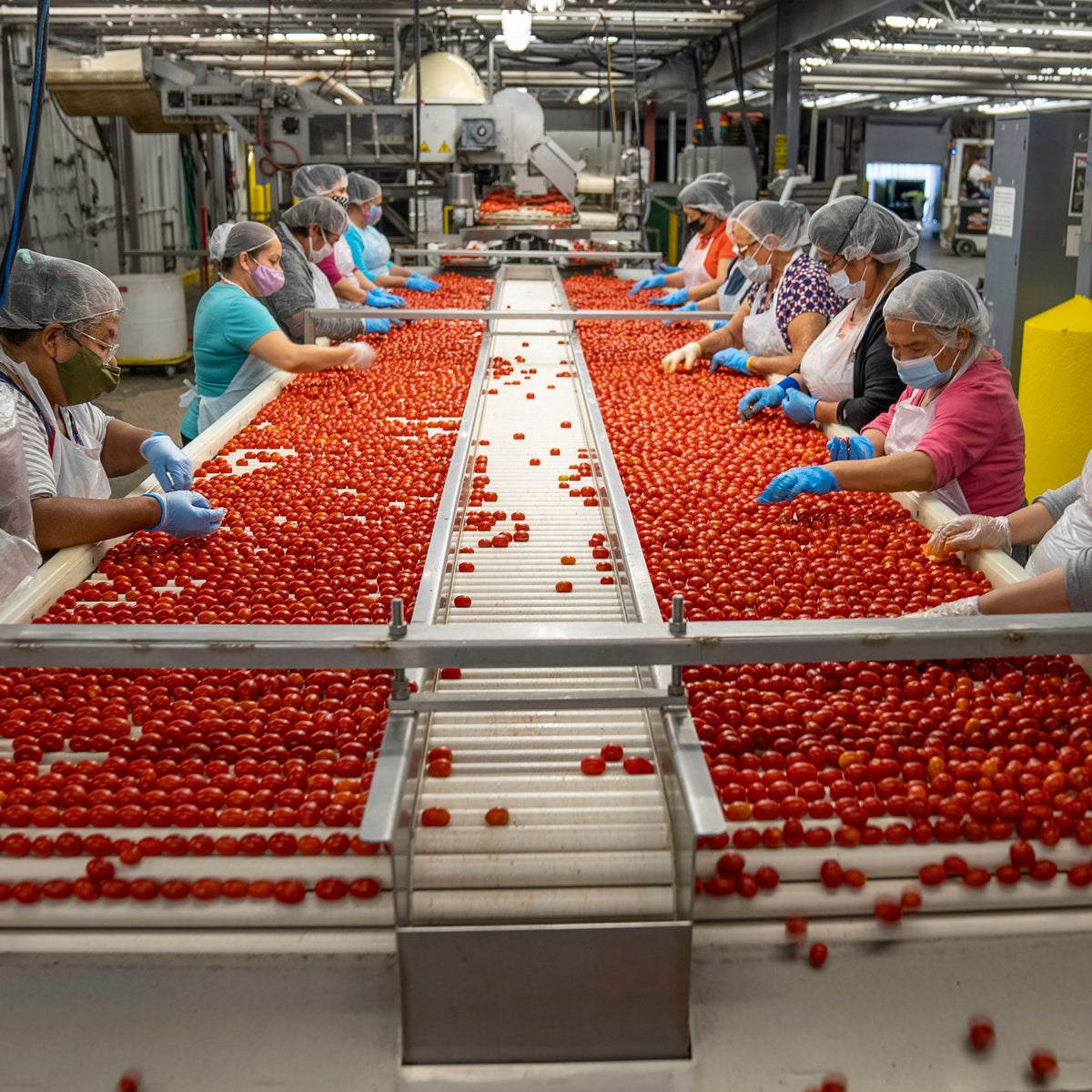
A packing house manager in apple country once described his October like this: eighteen-hour days, a sorter that rejects good fruit when the weather turns damp, and a compressor that runs flat out from the first bin dump until the last pallet is wrapped. Then in March the whole building goes quiet and the same compressor idles for weeks. Nobody sizes a system for that swing on purpose, and it shows.
Compressed air for produce packing houses has three things going for it that make it unlike most food plants: it is seasonal, it is cold, and it is wet. This article covers where air actually gets used between the bin dumper and the loading dock, what the air has to be, and the one place where we will tell you straight that a big job belongs with a specialist.
Where a packing line uses air
Every house is different, but most fresh packing lines pull air in the same handful of places.
- Optical sorters. Cameras and lasers look at each piece, and a bank of ejector valves fires a puff of air to knock out the rejects. One commercial optical sorter that handles dried fruit, fresh fruit, vegetables, nuts and frozen produce lists a compressed air requirement of 6 to 10 bar, which is roughly 87 to 145 PSI. Those valves open and close in milliseconds and they hate water.
- Packing and bagging machines. Form-fill-seal machines, bag openers, carton erectors and case packers run on pneumatic cylinders and grippers.
- Palletizers and conveyors. Diverters, stops and pushers are almost always pneumatic. They are small loads individually and add up across a building.
- Labeling and coding. Label applicators, print-and-apply units and ink jet coders use air for blow-on and for keeping their heads clean.
- Application of coatings and washes. Wax and fungicide applicators and spray bars may use air for atomizing or for valve actuation, depending on the line.
- Blow-off and drying. Many houses use blowers for bulk water removal, but compressed air nozzles show up at the end of the washer, at labelers, and anywhere a piece has to be dry before it gets a sticker. If you still blow off with a drilled pipe, engineered nozzles cut the air bill hard.
- Instrument and process controls. Pneumatic valves on the washer, hydrocooler and refrigeration systems.
Why cold changes the dryer you need
This is the part most people miss. Fruit is stored cold, and so are many of the rooms around it. The Washington State University tree fruit program notes that commercial Honeycrisp is stored at 37 degrees F and Fuji at 33 degrees F. If compressed air piping runs through or along those rooms, or a drop sits in a cold dock, the pipe wall sits at that temperature.
A standard refrigerated dryer delivers a pressure dew point around +3 degrees C, about 37 degrees F. That is right at the temperature of the room. Any moisture the dryer leaves behind will condense in the pipe and can freeze in a 33 degree F room. The ice then slows or blocks flow and the sorter valves downstream starve for air.
| Piping environment | Dryer that holds up | Why |
|---|---|---|
| Heated packing hall, lines stay above 50 F | Refrigerated dryer (+3 C / 37 F dew point) | Pipe never gets colder than the dew point |
| Lines pass through or along rooms at 33 to 37 F | Desiccant dryer (-40 F dew point or better) | Dew point sits far below the coldest pipe wall |
| Outdoor runs to bin dumps or dock doors in winter | Desiccant dryer, or keep the pipe heated and insulated | Outdoor temperatures drop below any refrigerated dew point |
A desiccant air dryer costs more to run than a refrigerated one because it uses purge air or heat to regenerate, so most houses dry the whole system with a refrigerated unit and put a desiccant dryer on the branch that crosses the cold zone. Our article on refrigerated vs desiccant air dryers lays out the trade. A related problem, and a solid case study, is in our cold storage warehouse guide.
What the air has to be
There is no single federal number for compressed air in a produce house, but the framework is familiar. Under the FDA's preventive controls approach and the GFSI-benchmarked audit schemes such as SQF and BRCGS, an auditor will ask how you control compressed air as a possible source of contamination. They want to see a written risk assessment, a filter change schedule and some proof that the air is what you say it is.
Industry guidance, including the British Compressed Air Society's food grade approach, commonly cites ISO 8573-1 classes of 2:2:1 for air that contacts food directly, and 2:4:2 for indirect contact. In plain terms, direct contact calls for a -40 C pressure dew point and an oil limit of 0.01 mg/m3 or better, and indirect contact allows a +3 C dew point. Most air in a packing house is indirect: it drives a cylinder or a sorter valve and never touches fruit. Air that blows across a piece of produce, opens a bag you are about to fill or conveys nuts is direct. Treat that branch more strictly. For a refresher on what auditors look for, read food grade compressed air requirements and the ISO 8573-1 class breakdown.
Oil is the other problem. Most packing houses run oil-lubricated rotary screw compressors with coalescing filters, and that works when the filters are changed on time. If any branch is direct contact and you want oil out of the equation, an oil-free compressor or a point-of-use treatment package for that branch is the cleaner call. Our coalescing filters are where the bulk of the oil comes out.
Sizing for a season with two speeds
A packing house compressor has to meet the peak of the season and still behave sensibly in the shoulder months. A few habits help.
- Size to the line, not the building. Add up the air for each machine that runs at once, then apply a realistic diversity factor. (We cover that in diversity factor.) Adding every nameplate overbuys.
- Use a variable speed unit for the trim. A fixed-speed machine sized for harvest runs unloaded for much of the year. A variable speed drive compressor follows the load. The variable speed rotary lineup is where to start.
- Add storage near the sorters. Ejector valves demand short bursts. A receiver close to the sorter with a pressure flow controller keeps header pressure steady while the sorter fires.
- Plan a standby. If the sorter goes down at the peak of harvest, you lose fruit. Two smaller machines in a lead and lag arrangement beat one large one. (See what happens when your only compressor goes down.)
Controlled atmosphere storage: where we stop
Many fruit operations also run controlled atmosphere rooms. In controlled atmosphere (CA) storage, the oxygen level is pulled down to slow the fruit's respiration. The WSU tree fruit program notes that 1 to 3 percent oxygen and 0.5 to 2.5 percent carbon dioxide are commonly used for apples, with Honeycrisp at 2 to 4 percent oxygen and Fuji at 1 to 2 percent. Nitrogen generators are one way to get the oxygen down, since nitrogen displaces it without chemicals, and membrane units suit high flow at lower purity while PSA units suit higher purity.
Here is the honest part. A full commercial CA complex, with multiple gas-tight rooms and the controls to hold them within a fraction of a percent, is engineered by CA specialists, and the nitrogen plant is sized to the room volumes and leakage. We carry nitrogen generators in the smaller range, including membrane units, and they fit small rooms, research storage and pilot work. If you are building or expanding a large CA system, bring in a CA contractor to size it. We are glad to supply the compressed air, dryers and filtration that feed the generators, and to help with the nitrogen generator that suits a small room. Our nitrogen generator guide explains the PSA and membrane choice.
Mistakes packing houses make with air
- Letting a refrigerated dryer feed a pipe that runs through a cold room. The ice shows up in March and nobody connects it to the dryer.
- Dirty or wet sorter air. Sticky ejector valves look like a sorting software problem. They are usually water or oil.
- Using galvanized or black iron. Rust flakes get into valves and cylinders in a wet plant. Aluminum or stainless pipe stays clean. Our aluminum compressed air pipe does not rust or scale.
- No condensate plan. A washdown plant puts out a lot of water. Use zero-loss drains, not timer drains that hiss all day (here is what that hiss costs).
- Treating every branch as indirect contact. Blow-off that touches fruit or product is a different branch and needs different air.
- Running one compressor through harvest. The season is short and the cost of an outage is high.
Frequently Asked Questions
What air quality does a produce packing house need?
There is no single federal figure, but auditors under GFSI schemes such as SQF and BRCGS expect a documented risk assessment. A common industry target is ISO 8573-1 class 2:2:1 for air that touches food and 2:4:2 for indirect contact. Most packing line air is indirect, but blow-off on product and bagging air are direct.
Why does my optical sorter reject good fruit on humid days?
Water in the air line sticks ejector valves, so they fire late or not at all. Check the dew point at the sorter, the drain on the receiver and the filter drains. One commercial optical sorter is listed at 6 to 10 bar of compressed air, and pressure dips during fast firing make it worse.
Do I need a desiccant dryer?
If any compressed air pipe runs through a room at 33 to 37 degrees F, or outdoors in winter, yes, for that branch. A refrigerated dryer's dew point is about 37 degrees F, which is no protection in a cold room. In a heated packing hall, a refrigerated dryer is usually enough.
Can I make nitrogen on site for CA rooms?
Yes, with a nitrogen generator, but a full commercial CA complex needs specialist design. We supply nitrogen generators in the smaller range and the compressed air treatment that feeds them. Have a CA contractor size anything large.
Tell us the sorter count, the coldest room your piping touches and your harvest peak, and we will help you pick the compressor, dryer and filtration. Start with the desiccant air dryers if your piping crosses a cold zone.


