


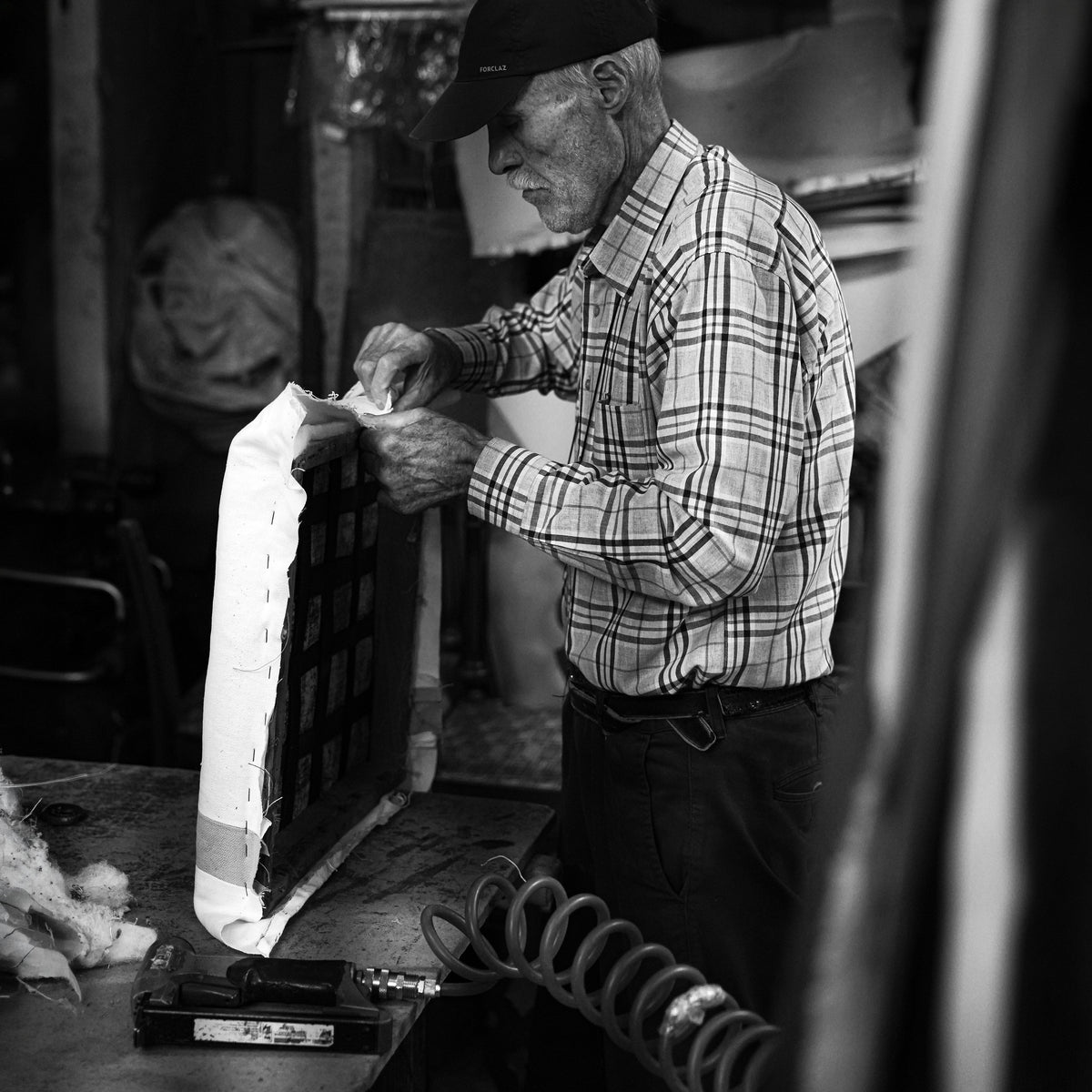
Walk into a box spring line at ten in the morning and you will hear it before you see it: a steady chatter of heavy staplers, forty or fifty shots a minute per operator, each one a short hard pull on the air system. Walk into the sewing room next door and the air demand is a whisper by comparison. Walk out to the compressor room and you will often find a cooler packed with white fiber like a dryer's lint trap.
That is the shape of compressed air for mattress and upholstered furniture plants. It is not a clean-room job and it is not a heavy-iron job. It is a lot of staplers and glue guns, a lot of drops, and a lot of lint. Here is what the system needs, what gets in its way, and how to size it so the last stapler on the line hits as hard as the first.
Where the air goes
Plants vary, but most of the air demand lives in a handful of places.
- Box spring and frame assembly. Pneumatic staplers fasten rails, slats, wire grids and cover fabric. This is the heaviest user in many plants by headcount and by duty.
- Upholstery stations. Fine-wire staplers and tackers set fabric, dust cover and trim. Lighter shots, more stations.
- Foam fabrication and lamination. Spray guns apply adhesive between foam layers. Air-operated pumps feed the glue. Cutting and shaping is mostly electric, but the adhesive and clean-up side runs on air.
- Spring unit and coil assembly. Cylinders on pocketed coil and Bonnell assembly machines.
- Quilting and sewing rooms. Pneumatic presser feet, thread trimmers and fabric clamps. Small users, but there are many.
- Compression, roll-packing and bagging. Cylinders and clamps on the packaging end.
- Blow-off and clean-up. Operators clearing fiber and foam dust off benches and machines.
Why staplers are not like a nail gun in a garage
A staple gun on a production line is cycled constantly. Compare it with a homeowner's finish nailer and you see why a plant system has to be different. Air demand from a stapler is a short spike on every trigger pull, and when twenty operators are firing in a rough rhythm those spikes stack. The compressor does not see an average, it sees pressure sag at the end of a long run of pipe.
Most pneumatic staplers and tackers want somewhere between about 70 and 100 psi at the tool, and the tool maker's manual will give your exact range. The trap is that the compressor can be set at 110 psi and the tool at the end of a long, small-diameter drop still sees 80. Pressure falls through hose, couplers and undersized pipe. Our guide to diversity factor explains why you should not just add up every tool on the floor, and why you also should not ignore the stack-up when many fire together.
Lint, foam dust and the compressor room
This is where upholstery and mattress plants differ most from a normal shop. Polyester fiber, cotton batting and foam dust are in the air all day. Three things follow.
- Intake filters and coolers clog. A compressor drawing air from the plant floor pulls lint into its intake filter and packs it into the cooler fins. The machine overheats, trips, and the first sign is a high-temperature shutdown on the hottest afternoon. Put the compressor in its own room, give it a ducted intake from clean air, and clean the cooler on a schedule. Our guide to compressor room requirements covers space, air and power.
- Fiber is fuel. A build-up of foam dust and fiber around a hot machine is a fire risk, not just a nuisance. Keep the compressor room swept, keep the motor and cooler clear, and do not store batting or foam in there.
- Lint finds the filters. Particulate filtration ahead of the dryers and at point of use pays for itself here.
If you want a comparison from a neighboring trade, we wrote about the same problem in compressed air for textile mills, where cotton and synthetic fiber is the whole story.
Air quality: modest, but not zero
Upholstery staplers do not need Class 0 air. They do need air that is dry enough that water does not rust the tools, wash the lube out of them or leave water spots on fabric. A refrigerated dryer is the right answer for almost all of this plant. A +3 C (37 F) pressure dew point is plenty for staplers and cylinders. The place to be more careful is the spray adhesive station. Water in the air line makes spray patterns spit and can interfere with the adhesive, and oil carryover from a tired compressor can show up as a failed bond between foam layers. Put a coalescing filter ahead of that station and drain it daily.
Browse refrigerated air dryers for the main line, and add a point-of-use filter at the adhesive booth.
The standards behind the product
The flammability rules for mattresses and upholstered furniture drive a lot of what happens on the floor, so it helps to know them even though they do not set your air spec.
- 16 CFR 1633 is the federal open-flame standard for mattresses and mattress sets.
- California TB 117-2013 is the smolder standard for upholstered furniture components, and many manufacturers build to it nationwide.
Why mention them in a compressed air article? Because adhesive and fastening quality shows up in test results. A weak bond or a missed staple is a manufacturing defect first and a compliance question second. Clean, dry, consistent air is a cheap way to avoid both.
Sizing the system
Do not size from the number of staplers times their rated cubic feet. Size from a realistic duty cycle. Here is the method with example numbers you should replace with your own tool specs.
| Area (example) | Stations | Assumed SCFM at full demand | Likely to run together? |
|---|---|---|---|
| Box spring staplers | 8 | 4 each | Most of the time |
| Upholstery tackers | 12 | 2 each | About half |
| Spray adhesive guns | 2 | 12 each | Yes |
| Coil and spring assembly | 2 machines | 10 each | Yes |
| Sewing and quilting room | 1 room | 15 total | Yes |
| Packaging and blow-off | 1 area | 20 total | Often |
Adding the demand that runs together in this example gives roughly 32 for the box spring line, 12 for upholstery, 24 for adhesive, 20 for coil machines, 15 for sewing and 20 for packaging, about 120 SCFM. Add 15 to 20 percent for leaks and growth and you land near 140 to 145 SCFM, which is a 30 HP class rotary screw at typical plant pressure. Your numbers will differ. The point is that the method, not horsepower, drives the answer.
Rotary screw is the right fit for a plant like this because it runs all shift without complaint. See our rotary screw air compressors for fixed and variable speed options. Because stapler demand comes in bursts, a good-sized wet receiver and a dry receiver after the dryer smooth the spikes so the compressor is not chasing every shot.
Piping and drops
Long runs of 1/2 inch pipe feeding a bank of staplers cause more complaints than any compressor. Run a loop main sized for the whole plant, then drop from the top of the main to each bench with a filter, regulator and quick coupler at the end. Size the hose to the tool. A 1/4 inch hose to a heavy stapler loses pressure fast; 3/8 inch is the usual step up on production lines. If you are using hose reels, see our hoses and reels.
Mistakes we see
- Compressor in the corner of the plant. It eats lint and overheats. Give it a room.
- Regulator set high to compensate for pressure drop. That wastes energy and shortens tool life. Fix the drop instead.
- No dryer. Staplers rust, adhesive guns spit and the bench air line drips.
- Dead-end headers. The last bench always starves. Loop the main.
- Blowing down with open hose. OSHA 29 CFR 1910.242(b) limits cleaning air to 30 psi at the nozzle, and fiber blown into the air is a housekeeping and fire problem anyway. Use a vacuum or an engineered blow gun.
Frequently Asked Questions
How much air do pneumatic staplers need in a mattress plant?
It depends on the model and how fast operators fire it, so use the tool maker's consumption figure and a realistic duty cycle. Most staplers want roughly 70 to 100 psi at the tool. The bigger challenge is delivering that pressure at the end of a long drop.
Do I need a dryer for upholstery staplers?
Yes. A refrigerated dryer keeps water out of the tools and off the fabric, and it protects the spray adhesive station. Add a coalescing filter at the adhesive booth.
Why does my compressor overheat in the summer at our furniture plant?
Check the cooler and intake filter for lint before anything else. Fiber packs the fins and restricts airflow. A dedicated, ventilated compressor room with a ducted clean-air intake solves most of it.
Is rotary screw or piston better for an upholstery plant?
For a plant that runs full shifts, rotary screw is the better fit. Piston compressors can work in a small shop with low duty, but they struggle with all-day staple demand.
Do you sell the staplers and glue guns?
We sell the compressed air system: compressors, dryers, filters, receivers, pipe and some tools and hose. For production staplers and adhesive equipment, buy from the tool or adhesive supplier, then size the air system to their consumption figures.
Where to go from here
If your last stapler is soft or your compressor trips in July, look at three things in this order: the cooler and intake filter, the pressure at the end of the longest drop, and the water in the line. When you are ready to size a new machine for your mattress and upholstered furniture plant, start with the rotary screw air compressors and work toward the floor.


