


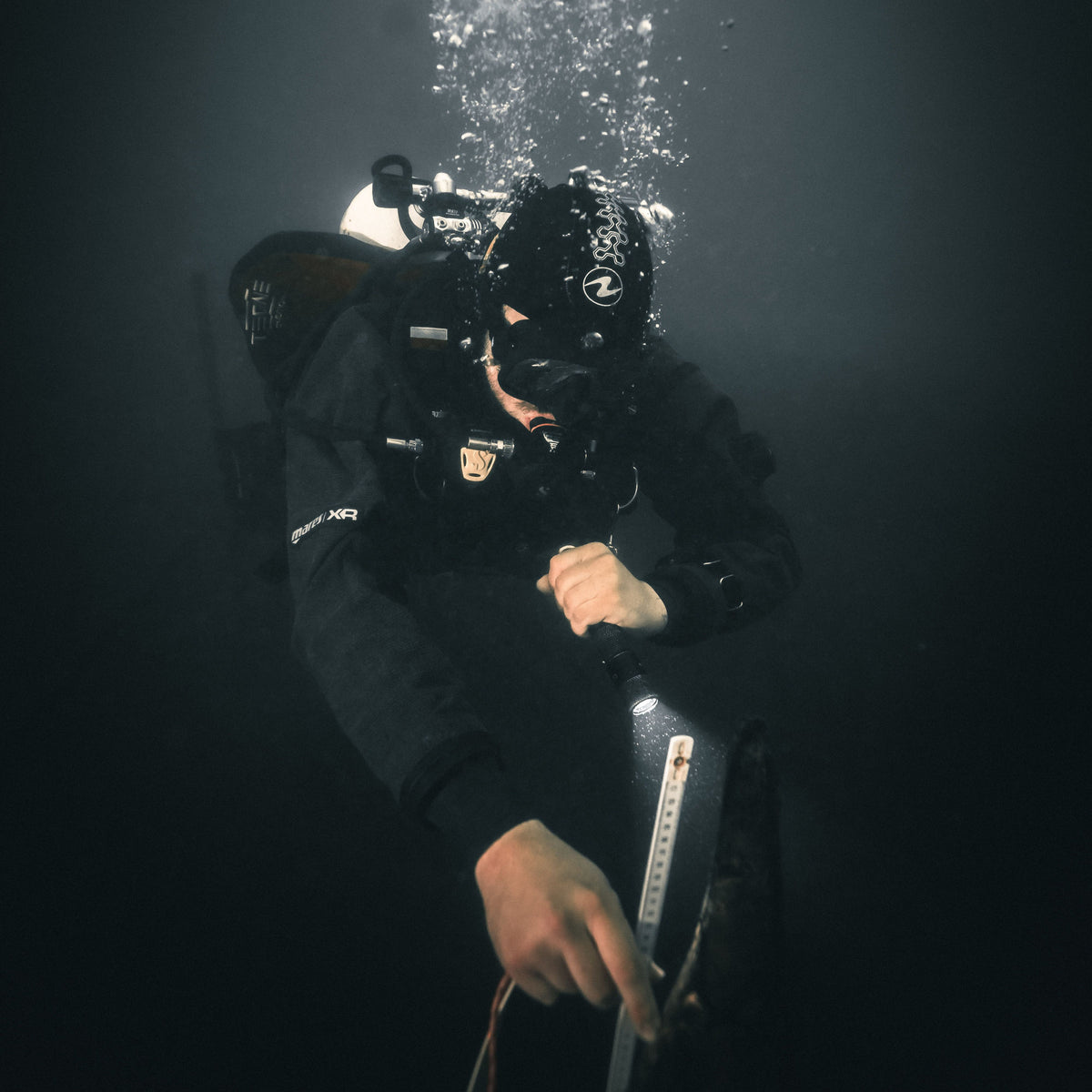
The supervisor on a bridge pier job told us about the morning his diver called up and said the air tasted like a gas station. The compressor on the deck was an oil-lubricated unit with a two-stage filter and nobody could remember the last time the cartridge was changed. The dive stopped, the diver came up fine, and the crew spent the rest of the day finding out why. It is a short story with a good ending, and it is the reason this article exists.
Compressed air for commercial diving is a different job from compressed air for a shop. The air goes straight into a person's lungs, at depth, through a hose that may be hundreds of feet long. There is no second chance at the surface for a bad cartridge. Here is what the surface side of a diving operation needs, and where we can help and where we cannot.
What we can and cannot supply
Let's be upfront about this first. Warthog does not sell scuba cylinder fill compressors, the 3,000 to 5,000 PSI machines a dive shop uses to fill tanks. We also do not sell dive consoles, umbilicals, helmets or full-face masks. Those come from the dive equipment makers, and your dive plan and equipment specs should drive them.
What we do sell is the low-pressure air side that feeds a surface-supplied system: rotary screw and piston compressors, receiver tanks, dryers, filtration, and Nano breathing air purification (twin-tower desiccant purification dryers, modular purifier systems, purification modules and portable panels). If you run surface-supplied air from a low-pressure compressor, or you are building a purification train in front of a console, that is the part of the system this article covers.
How surface-supplied diving uses air
A surface-supplied diver gets a continuous flow of air through an umbilical. The supply pressure at the surface has to cover the depth pressure, the pressure lost in the hose, and a margin for the diver's breathing demand. That is why the numbers rise with depth.
Kirby Morgan publishes supply pressure tables for its helmets that show the pattern. For low-pressure compressors and consoles limited to roughly 220 PSIG or less, the recommended supply pressure in the SuperFlow table runs from 125 PSIG at 0 to 50 feet of seawater up to 250 PSIG at 165 to 190 feet. Their older rule of thumb multiplies depth in feet by 0.445 PSI and adds an over-bottom pressure of 90 PSIG for 0 to 60 feet, 115 for 61 to 100, 135 for 101 to 132, 165 for 133 to 165, and 225 for 166 to 220 feet. Use the manufacturer's current table for your actual helmet, because those numbers move with the equipment.
Flow is the other half. The same tables size flow around the diver's respiratory minute volume (RMV). Planning for at least 40 to 62.5 RMV is the guidance. As an example from the low-pressure table, a supply at 90 PSIG and 40 RMV is good for a maximum depth of 76 feet and calls for about 5.6 SCFM. At 220 PSIG and 40 RMV, the table lists 220 feet and about 13 SCFM. That is per diver, and it includes a 20 percent safety margin. Two working divers is double that before you count a standby diver on the same supply.
| Diver work rate | Typical air consumption at the diver (CFM) |
|---|---|
| Rest | 0.2 - 0.35 |
| Light work | 0.35 - 0.7 |
| Moderate work | 0.7 - 1.3 |
| Heavy work | 1.3 - 1.9 |
| Severe work | 1.94 - 3.5 |
Those are consumption figures at the diver, at depth pressure. The compressor has to deliver that flow in surface SCFM at the pressure that gets it down the hose, which is why the table values above are much larger. Do not size a diving compressor off the first table. Size it off the supply pressure and flow tables for your gear and your deepest planned depth.
What OSHA says about the air itself
The commercial diving rule, 29 CFR 1910.430, is specific about the compressor side. A compressor supplying a diver must have a volume tank with a check valve on the inlet, a pressure gauge, a relief valve and a drain valve. Compressor intakes have to be located away from areas containing exhaust or other contaminants. The air going to the diver may not exceed 20 ppm carbon monoxide, 1,000 ppm carbon dioxide or 5 mg/m3 of oil mist, and it cannot have a noxious or pronounced odor. The output of the compressor system has to be tested for air purity every 6 months at the connection to the distribution system. Oil-free compressors are exempt from the oil mist test.
Notice that the OSHA diving limit for CO is 20 ppm. The respirator rules use Grade D breathing air, which caps CO at 10 ppm, oxygen between 19.5 and 23.5 percent, condensed hydrocarbons at 5 mg/m3 and CO2 at 1,000 ppm. For moisture, Grade D calls for a dew point no more than 10 degrees F below the use temperature when the air comes from a compressor. We would build to the tighter numbers. Our Grade D breathing air guide walks through what that takes. Which rule your operation falls under is a question for your safety officer, because the rules differ for commercial, scientific and public safety diving.
The same rule covers the hose. Breathing gas hoses must have a working pressure at least equal to the system working pressure and a burst rating of at least 4 times that pressure, and they get tested at least annually to 1.5 times working pressure. Open hose ends need to be taped, capped or plugged when not in use. Compressed air systems above 500 PSIG need slow-opening shut-off valves. And surface-supplied masks and helmets need a minimum ventilation rate of 4.5 ACFM at operating depth.
The purification train, in order
An oil-lubricated compressor is the usual choice for diving work, because it is the machine people can buy, service and repair in the field. That puts the burden on the purification train. The order matters, and it is the same logic as any treatment train.
- Aftercooler and water separator. Take the heat out and knock out the bulk liquid right at the compressor.
- Volume tank. Required by the rule, and it also smooths pulsation so your filters see steady flow.
- Coalescing filtration. Pull the oil aerosol out before it reaches the adsorption stage, which can be ruined by liquid oil.
- Desiccant dryer or adsorption tower. Cold water makes moisture a real problem. Air that is dry at the surface can still freeze up a regulator or first stage when it expands in cold water, so dry air is a performance issue as much as a purity one.
- Activated carbon and catalyst stage. Carbon takes out vapor and odor. A carbon monoxide catalyst converts CO to CO2. Breathing air purifier modules combine these stages in one housing.
- Final particulate filter. Catches carbon dust and desiccant fines before the umbilical.
The Nano breathing air line covers this ground in a few formats. The BHD is a twin-tower desiccant purification dryer. The NBA is a modular purifier system, the NBM is a purification module, and the BAP and BAC are purification panels and portable cases that suit a job-by-job crew. Check each model's rated flow and pressure against your console or manifold before you order. Matching the purifier flow to your peak demand, not your average, is where people get hurt.
Where the compressor goes
This is where more problems start than anywhere else. A dive boat or barge has engines, generators and sometimes a welding rig, all producing carbon monoxide. A compressor intake sitting downwind of any of them is a bad day waiting to happen, and CO will not smell like anything.
- Put the intake upwind and away from engine exhaust, generator exhaust and any space where fumes collect.
- Run an intake line if you have to, and keep it clear of spray and bilge vents.
- If your compressor is engine-driven, keep that exhaust well away from the intake. Our diesel air compressor guide covers the gas and diesel machines.
- Use a continuous CO monitor downstream of the purifier if your operation can support one. A test every 6 months is the minimum, not the plan.
Mistakes we see on diving jobs
- Putting a shop compressor in front of the umbilical with no purification. A shop-grade filter is not a breathing air system, and the oil carryover from a worn ring set can easily exceed 5 mg/m3.
- Skipping the six-month test or testing the wrong point. The rule says at the connection to the distribution system. A sample from the compressor discharge does not count.
- Letting cartridges run past their life. Carbon and catalyst do not announce when they are spent. Keep a change log with hours, not dates.
- Undersized volume tank and receiver. A surge in demand when two divers take a heavy breath at once pulls pressure down at the diver.
- Long small-bore hose runs. Pressure drop in a long umbilical is a real number. If your supply pressure comes from a table, check that the table assumes your hose length.
- Open hose ends. Dirt in a hose end ends up in a helmet. Cap them.
A sizing approach that holds up
Start with the deepest planned depth and the number of divers in the water, including the standby. Pull the supply pressure and flow numbers from your helmet or mask manufacturer's table. Add the flow for every diver and a margin. Choose a compressor whose rated SCFM at the needed discharge pressure clears that number, not its max pressure rating alone. Size the receiver to ride through short demand peaks. Then pick the purification train to pass the full flow with headroom.
If you already have a compressor and need to know what treatment fits it, browse the air compressor lineup for sizing and then match a purification module to the flow. For jobs that need dry air beyond the purifier stage, our desiccant air dryers add a dedicated drying step.
Frequently Asked Questions
Can I use a regular shop air compressor to supply a diver?
Not by itself. Shop air has oil aerosol, water and possibly carbon monoxide that were never meant to be breathed. A compressor can be part of a diving air system only with a volume tank, proper purification, an intake placed away from exhaust, and the testing the diving rule requires. Check your operation's rule set before you commit.
How often does diving air have to be tested?
Under 29 CFR 1910.430, the output of the compressor system must be tested for air purity every 6 months, at the connection to the distribution system. Oil-free compressors are exempt from the oil mist test. Many operators test more often than the minimum.
Do I need an oil-free compressor for surface-supplied diving?
No, the rule does not require one. Oil-lubricated compressors are common when the purification train is sized and maintained correctly. An oil-free machine removes oil mist as a concern at the source and exempts you from that test, but you still need drying and the other stages.
Can you supply a compressor to fill scuba tanks?
No. Scuba fill compressors run at 3,000 to 5,000 PSI and we do not carry them. We cover the low-pressure compressors, receivers, dryers, filters and breathing air purification that sit upstream of a surface-supplied system.
If you are building or upgrading the surface side of a dive operation, start with the Nano purification line and tell us your depth, diver count and compressor. We will help you match the flow.


