


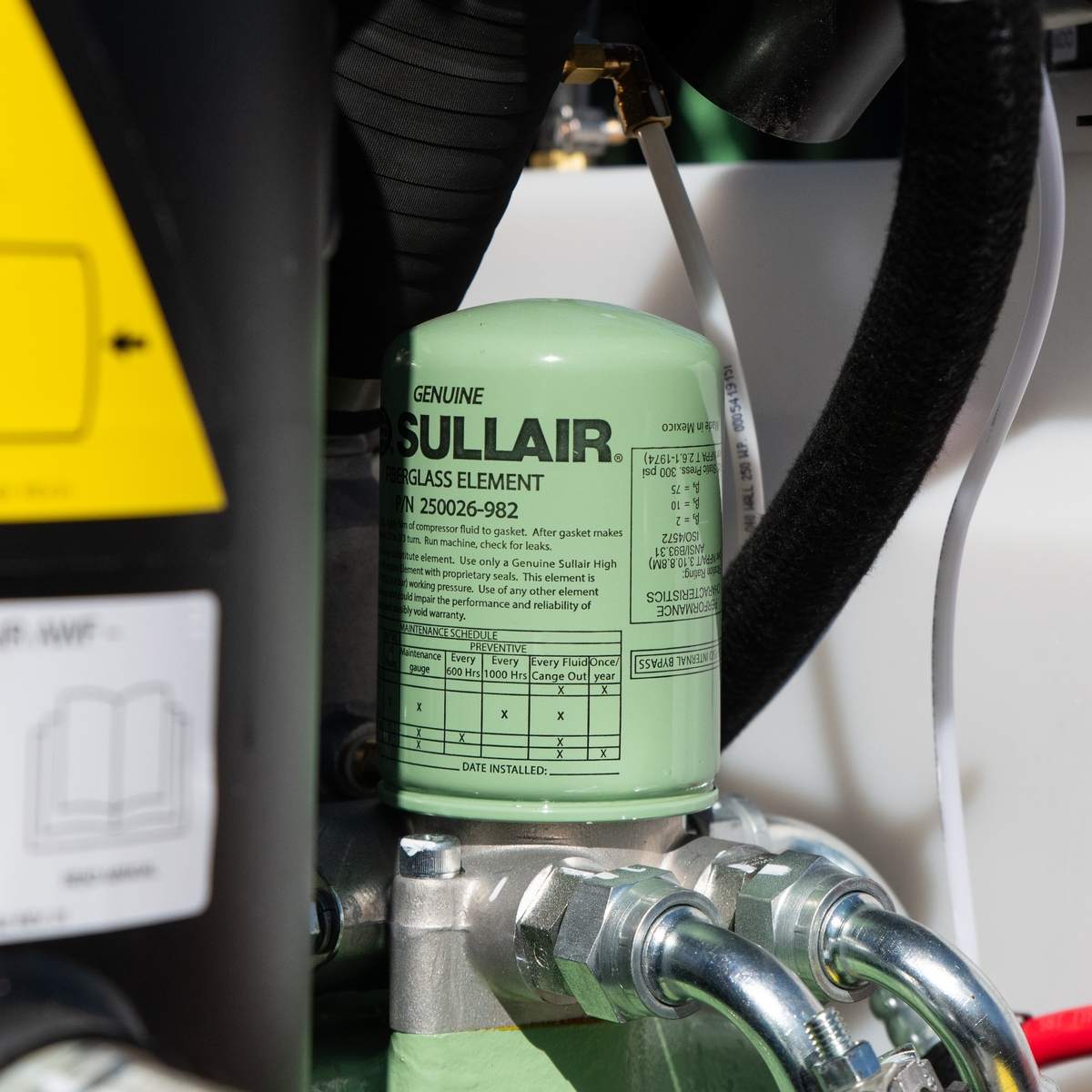
Somebody calls and says "I need a filter for my Sullair." That's about as useful as walking into an auto parts store and asking for a belt for your truck. Sullair has been building rotary screw compressors since 1965 and the catalog behind that name runs to tens of thousands of part numbers across stationary, portable, and oil-free lines.
The good news: finding the right Sullair air compressor parts is mostly a matter of reading one plate and knowing which three numbers matter. Here's how to get it right the first time.
Start at the Data Plate, Not the Part
Before you look at the broken thing, find the machine's nameplate. On stationary rotary screws it's usually on the frame near the control panel or inside the door on the electrical enclosure. On portables it's on the frame rail or inside the canopy.
What you need off it:
- Model number. Something like LS20, LS16, ES-6, SRL, 185, or 375H. This is the single most important piece of information.
- Serial number. Sullair has run running changes mid-model for decades. Two LS20 units built four years apart can take different separator elements. The serial is how you get past that.
- Rated pressure and horsepower. A 100 PSI machine and a 125 PSI machine of the same model can take different minimum pressure valve springs and different control settings.
Photograph the plate. Do it once and keep it in the maintenance file, because in five years that plate will be under a layer of oil film and unreadable and you will be standing there with a flashlight.
Decoding a Sullair Part Number
Most Sullair part numbers you'll see look like 02250####-###, for example 02250120-955 or 02250125-657. That 02250 prefix is the long-running Sullair series and it shows up on everything from solenoid valves to thermal valves to filter elements.
You'll also run into shorter legacy numbers on older iron, and some pre-Hitachi-era numbers that were reissued. A number that returns nothing is usually superseded rather than wrong. Sullair, like every manufacturer, retires numbers and rolls the part into a newer one. If you have an old number off a box or a service record, it is still worth searching, because most catalogs carry the supersession.
The other place part numbers hide: the old element itself. Separator elements, oil filters, and air filters almost always have the number printed or stamped on the can or the end cap. Read it off the part you are pulling before you throw it away. That is the single highest-confidence way to order a replacement.
The Wear Items You Will Actually Buy
Ninety percent of Sullair parts orders are the same short list. If you run one of these machines, these are the numbers worth knowing by heart.
| Part | Typical interval | What happens if you stretch it |
|---|---|---|
| Air/oil separator element | 2,000 to 4,000 hours | Oil carryover into the air line, rising pressure drop, wasted energy |
| Oil filter | 1,000 to 2,000 hours | Bypass opens, unfiltered oil reaches the airend |
| Inlet air filter | 1,000 to 2,000 hours, less in dirty air | Restricted inlet, lost capacity, oil pulled past the seal |
| Compressor fluid | 2,000 to 8,000 hours by fluid type | Varnish, bearing wear, eventual airend failure |
| Inlet valve kit | As needed, watch for unloading faults | Won't unload, blowdown problems, hard starts |
| Minimum pressure valve | As needed | Oil carryover at start, no separator tank pressure |
| Thermal (thermostatic) valve | As needed | Overheat trips, or running cold and condensing water into the oil |
| Solenoid valves | As needed | Control faults, won't load or unload on command |
| Shaft seal | As needed | Oil leak at the drive end |
| Coupling element | Inspect annually | Vibration, then a very expensive morning |
Those hour intervals are starting points. Dirty intake air, high ambient temperature, or short-cycling all shorten them. If you want to stop guessing, send a sample out; our piece on reading a compressor oil analysis covers what the lab report is telling you.
OEM, OEM-Equivalent, and the Ones to Avoid
Three tiers exist and the middle one is where most shops should live.
Genuine OEM. Sullair-branded, in a Sullair box. Highest cost. Worth it when the machine is under warranty, when it's a critical production unit, or when the part is an airend component where a dimensional miss ends the machine.
OEM-equivalent from a known manufacturer. Built to the same spec, often on the same tooling, sold without the badge. This is the sweet spot for separators, oil filters, air filters, and most valves. Expect 30 to 50 percent less than list. The thing to check is the media spec and the burst rating, not the price.
Unbranded low-cost copies. Skip these on separator elements in particular. A separator that fails structurally dumps its media into your air system and you spend a weekend cleaning it out of every drop and filter in the building. The savings are not close to the risk.
One specific warning: compressor fluid. Sullair machines are filled from the factory with specific fluids, and mixing incompatible fluid types causes varnish and can void coverage. Match the fluid type to what's in the machine, and if you're switching types, flush properly rather than topping off. Our compressor oil guide covers the compatibility side.
How to Order Without a Second Phone Call
Send this and you'll get the right part the first time:
- Model number and serial number off the data plate.
- Rated pressure and horsepower.
- The part number off the old part, if you can read it.
- A photo of the old part if you can't.
- What the machine is doing wrong, in one sentence.
That last one matters more than people expect. Half the time somebody orders a solenoid valve and the actual problem is a plugged control line or a failed pressure transducer. Describing the symptom lets whoever is helping you catch that before you spend money on a part that won't fix it. Our general guide on ordering compressor parts goes deeper on this.
What to Keep on the Shelf
For a single production machine, stock one full service kit: separator, oil filter, air filter, and enough fluid for a change. That is the difference between a two-hour planned shutdown and a three-day wait with the plant running on a rental.
For a fleet of the same model, add a spare inlet valve kit and a spare thermal valve element. Those two parts fail without warning, they're the ones nobody has, and they're cheap relative to the downtime.
Do not stock airend components speculatively. If you're at the point of needing an airend, our piece on rebuilding versus replacing an airend is the decision you actually need to make.
Sullair-Specific Things That Trip People Up
Same model, different serial, different part. Said it above, saying it again, because it's the number one cause of a wrong part showing up. Always give the serial.
Portable versus stationary. A Sullair 185 towable and a Sullair LS series stationary share a brand and almost nothing else. Say which one you have.
Encapsulated versus standard separators. Some Sullair models use a spin-on separator, others a drop-in element with a gasket kit. Ordering the wrong style is common and the two are not interchangeable.
Ownership changes. Sullair has changed hands over the years, and part number lineages reflect that. An old number not resolving in a current catalog does not mean the part is unavailable.
Bottom Line
Ordering Sullair air compressor parts comes down to three things: read the data plate, read the number off the old part, and say what the machine is doing. Get those right and the rest is routine. Browse what we stock in compressor parts, or send the plate photo and the symptom and we'll work it back to a number.
Frequently Asked Questions
Where is the model and serial number on a Sullair compressor?
On stationary rotary screws, look on the frame near the control panel or inside the electrical enclosure door. On portables, check the frame rail or inside the canopy. Photograph it and keep the photo in the maintenance file, because the plate gets oil-filmed and unreadable over time.
Do I have to use genuine Sullair parts?
Not usually. OEM-equivalent filters, separators, and most valves from a reputable manufacturer perform the same and cost meaningfully less. Stay with genuine OEM while the machine is under warranty and for airend components, where a dimensional miss is expensive.
How often should I change the separator element?
Commonly 2,000 to 4,000 hours, but let pressure drop across the separator be your guide. Once it climbs past about 10 PSI, you are paying for that restriction in energy every hour the machine runs, and it is cheaper to change the element.
My part number doesn't come up anywhere. Is the part discontinued?
Probably not. It is far more likely superseded. Manufacturers retire numbers and roll the part into a newer one, and most catalogs carry the supersession. Search the old number anyway, and supply the model and serial so it can be traced.
Can I use a different compressor fluid than what came in the machine?
Only if it is compatible, and only with a proper flush. Mixing incompatible fluid types causes varnish and accelerates bearing wear, and it can affect warranty coverage. Match the existing fluid type or change it deliberately rather than topping off with whatever is on the shelf.


