


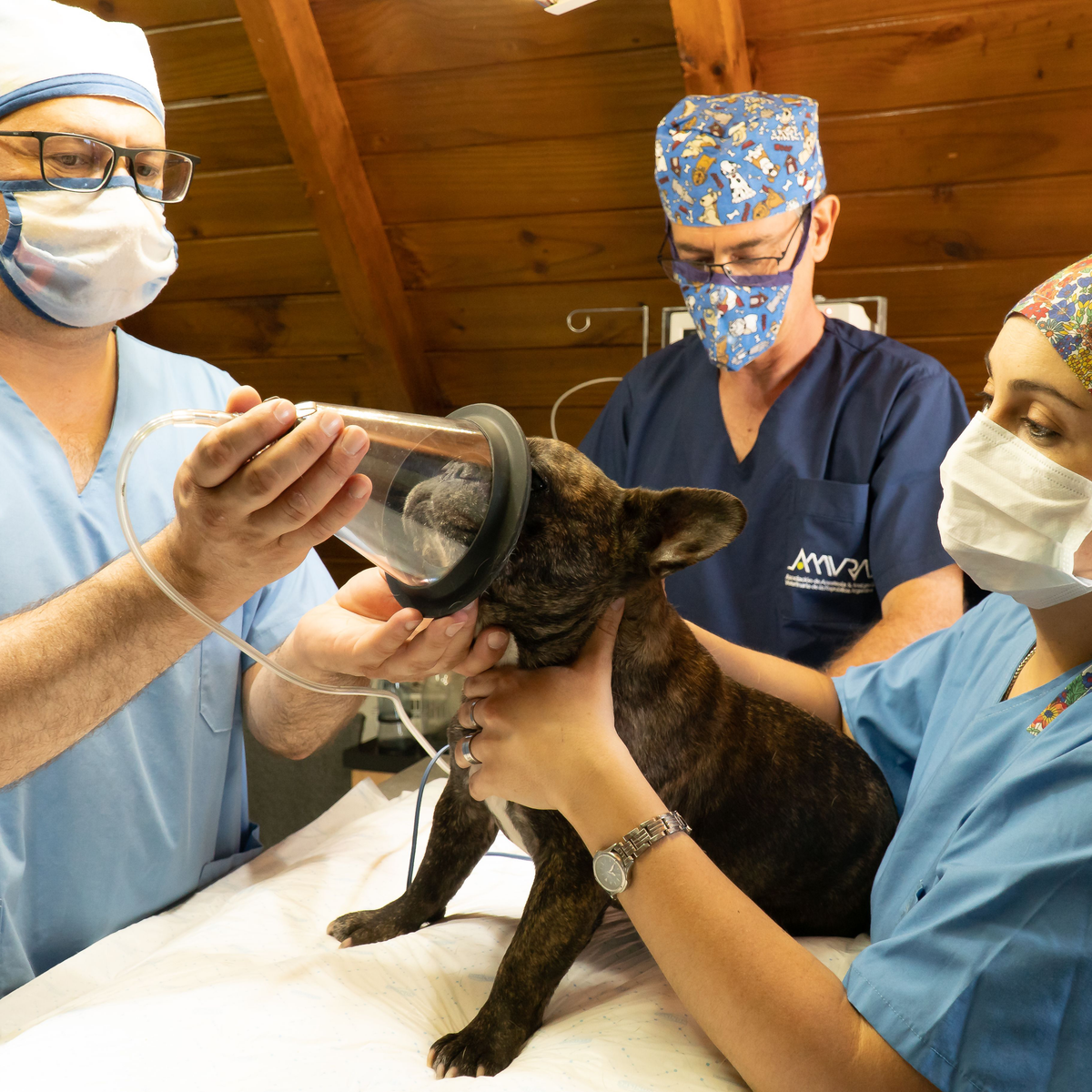
A vet tech is three hours into a Saturday dental block. The ultrasonic scaler on table two starts spitting, the high-speed handpiece on table one bogs down every time she leans on it, and the practice owner is standing in the utility closet wondering why the compressor he bought from a big-box store four years ago can't keep up with two tables and a surgical drill.
We get this call a lot. The compressor isn't broken. It was never sized for the job. Compressed air for veterinary clinics is a different animal from shop air, and most practices find that out the hard way, usually on a busy dental day.
What Makes a Veterinary Practice Different
Your air does three jobs that a body shop's air never has to do. It goes into a patient's mouth through a high-speed handpiece. It drives surgical instruments that touch bone. And it runs almost continuously for four or five hours during a dental block, then sits idle for a day.
That combination is unusual. You need clinical air quality on a small system, you need duty cycle that a typical single-stage piston can't deliver, and you need it quiet enough that it isn't rattling the wall behind an anesthetized patient.
Worth saying plainly: veterinary practices in the US are not regulated the way human hospitals are. NFPA 99 medical gas requirements and the certified medical air packages that come with them apply to human healthcare facilities. A vet clinic doesn't need a certified medical gas system, and we don't sell one. What you do need is oil-free, dry, filtered air, because your handpieces and your patients don't care what the code says. AAHA accreditation standards for dentistry and anesthesia push in the same direction.
Oil-Free Is Not Optional Here
A lubricated piston compressor carries oil aerosol downstream. Always. A good coalescing filter knocks most of it out, but "most" is the wrong target when the air is going through a handpiece into an open surgical field or a patient's airway.
Run an oil-free compressor for anything that touches a patient. Scroll and oil-free reciprocating designs both work. Scroll units run quieter and last longer between rebuilds; oil-free pistons cost less up front and are easier to service in a small building. Either one keeps hydrocarbon out of the line at the source instead of trying to filter it out after the fact.
If your practice also runs a shop area with air tools, a lift, or a wash bay, that is a separate conversation. A lubricated machine is fine out there. Just don't tie it into the clinical drop.
Sizing: Real Numbers
Size on peak simultaneous demand, not total connected equipment. On a dental day the peak is two or three handpieces plus a scaler, all pulling at once.
| Equipment | Typical air demand | Working pressure |
|---|---|---|
| High-speed dental handpiece | 2 to 4 CFM | 32 to 40 PSI at the handpiece |
| Low-speed handpiece / polisher | 2 to 3 CFM | 30 to 40 PSI |
| Ultrasonic scaler (air driven) | 2 to 3 CFM | 35 to 40 PSI |
| Air/water syringe | 1 to 2 CFM intermittent | 40 to 60 PSI |
| Pneumatic orthopedic drill or saw | 4 to 8 CFM while cutting | 100 PSI running |
| Table lift / restraint air | 1 CFM intermittent | 80 to 100 PSI |
Budget 4 to 8 CFM per active dental table as a working rule, and add the orthopedic load on top if you do fracture repair. A two-table general practice that also does the occasional TPLO lands around 10 to 14 CFM at 100 PSI. That is a 3 to 5 HP oil-free machine, not a 1.5 HP pancake.
One trap: those handpieces want 35 PSI at the head but your system has to sit at 90 to 100 PSI so the orthopedic drill has something to work with. Regulate down at the chair, not at the compressor. Set the tank at 100 to 120 PSI and put a proper regulator at each operatory drop. If you set the whole system to 40 PSI so the handpieces are happy, your surgical drill will feel like it's chewing through bone with a butter knife.
Tank Size Matters More Than You'd Think
A dental block is a long series of short, hard pulls. Storage smooths that out and keeps the motor from short cycling itself to death. Sixty gallons is a sensible floor for a two-table practice. Eighty is better if you have the corner to put it in. More tank also means the compressor runs longer and less often, which is easier on the motor and quieter overall, since it isn't kicking on every ninety seconds during a procedure.
Drying and Filtration
Wet air in a handpiece line is how you turn a $900 turbine into a paperweight. Moisture also carries whatever was living in the tank straight into the patient's mouth.
The minimum useful train for a clinic:
- Refrigerated dryer sized for your actual CFM, set for a 35 to 38 F pressure dew point. That gets you ISO 8573-1 Class 4 humidity, dry enough for indoor dental and surgical use.
- Coalescing filter after the dryer, 0.01 micron. This is your last defense against aerosol and fine particulate.
- Point-of-use filter and regulator at each operatory. Cheap, and it's the one that catches whatever the main train missed.
Some practices add an activated carbon stage after the coalescer to knock down odor and residual hydrocarbon. On a truly oil-free machine that is belt and suspenders, but it is cheap insurance and it makes the air smell like nothing, which patients and staff both appreciate. Our ISO 8573-1 class breakdown walks through what each number in a class spec actually commits you to.
Skip the desiccant dryer unless you have a specific reason. Minus 40 dew point is a spec for outdoor lines and pharmaceutical work. A clinic inside a heated building does not need it, and desiccant costs you purge air you'd rather spend on the handpieces.
Noise, Placement, and the Thing Everyone Forgets
Put the compressor somewhere it can breathe. A closet with no ventilation cooks the machine and shortens its life, and intake air that's already 100 F carries more moisture load into your dryer.
A few placement rules that save headaches:
- Give the unit 18 to 24 inches of clearance on the cooling fan side.
- Vent the room. If the closet hits 95 F on a summer afternoon, you need a louver or a fan, not a bigger compressor.
- Keep it off a shared wall with an exam room or a recovery ward if you can. Under 60 dBA is the target, and scroll units get there; oil-free pistons often don't.
- Slope the drop lines away from the operatories and put a drip leg with a drain at the bottom of each riser. Water runs downhill, so give it somewhere to go that isn't your handpiece.
The piping side has enough detail in it to deserve its own write-up, so if you are running new lines or retrofitting an older building, see our guide to compressed air piping for veterinary clinics, which covers line sizing, materials, drop takeoffs and per-room isolation valves.
Drain the tank. Every week, without fail, or fit an automatic drain and forget about it. Standing water is what turns a ten-year tank into a five-year tank, and it's the single most skipped item on every maintenance list we've ever seen in a clinic.
What Practices Get Wrong
Buying on horsepower instead of CFM. A 5 HP oil-free machine and a 5 HP lubricated machine do not deliver the same air. Oil-free runs less efficiently per horsepower, so read the CFM at 100 PSI off the data plate and ignore the badge.
Sizing for one table because that's what you have today. You will add a table. Everyone does. Buy for where the practice is going in three years, because retrofitting a bigger compressor into a closet you already sized is a bad afternoon.
Running the whole clinic at 40 PSI. Covered above, but it comes up constantly. Regulate at the point of use.
Treating the dryer as optional. The dryer is cheaper than the handpieces it protects. This is not close.
Tying the shop compressor into the clinical line. Oil aerosol is the whole reason you bought oil-free. Don't undo it with a convenience tee.
Where to Start
Count your tables, add up the peak simultaneous CFM from the table above, add 30 percent for growth and leaks, and shop oil-free compressors at that number. Then pick a refrigerated dryer rated at or above the compressor's output and a coalescing filter to match. If you also run a dental-only operation, our dental air compressor guide covers the human-side equivalent in more depth, and most of it carries over.
Getting compressed air for veterinary clinics right is not complicated. It's oil-free at the source, enough CFM for a real dental day, a dryer that actually runs, and pressure regulated where the tool is. Do those four things and the air stops being something you think about.
Frequently Asked Questions
Can I use a regular shop compressor for veterinary dental work?
Not for anything that touches a patient. A lubricated compressor puts oil aerosol into the line, and filtration reduces it rather than eliminating it. Use an oil-free machine for clinical air and keep the lubricated one on the shop side if you have one.
How many CFM do I need for two dental tables?
Plan on 4 to 8 CFM per active table, so 8 to 16 CFM for two. Add 4 to 8 CFM if you run pneumatic orthopedic instruments, then add roughly 30 percent headroom. Most two-table practices land on a 3 to 5 HP oil-free unit.
Do veterinary clinics have to meet NFPA 99 medical air requirements?
No. NFPA 99 medical gas requirements apply to human healthcare facilities. Veterinary practices are not covered, and certified medical air packages are not something we supply. The practical target is oil-free, dry, filtered air, which AAHA accreditation standards for dentistry and anesthesia effectively push you toward anyway.
Refrigerated or desiccant dryer for a clinic?
Refrigerated, almost always. A 35 to 38 F pressure dew point is plenty for indoor use and costs far less to buy and run. Desiccant is for outdoor piping or specs that demand minus 40 F, and it burns purge air you would rather have at the handpiece.
Why does my handpiece lose power even though the gauge reads 100 PSI?
The gauge is probably at the tank, not at the tool. Undersized drop tubing, a restrictive quick coupler, or a regulator that can't pass the flow will drop 20 or 30 PSI between the tank and the handpiece. Put a gauge at the operatory and measure it while the tool is running, not while it's sitting still.


