


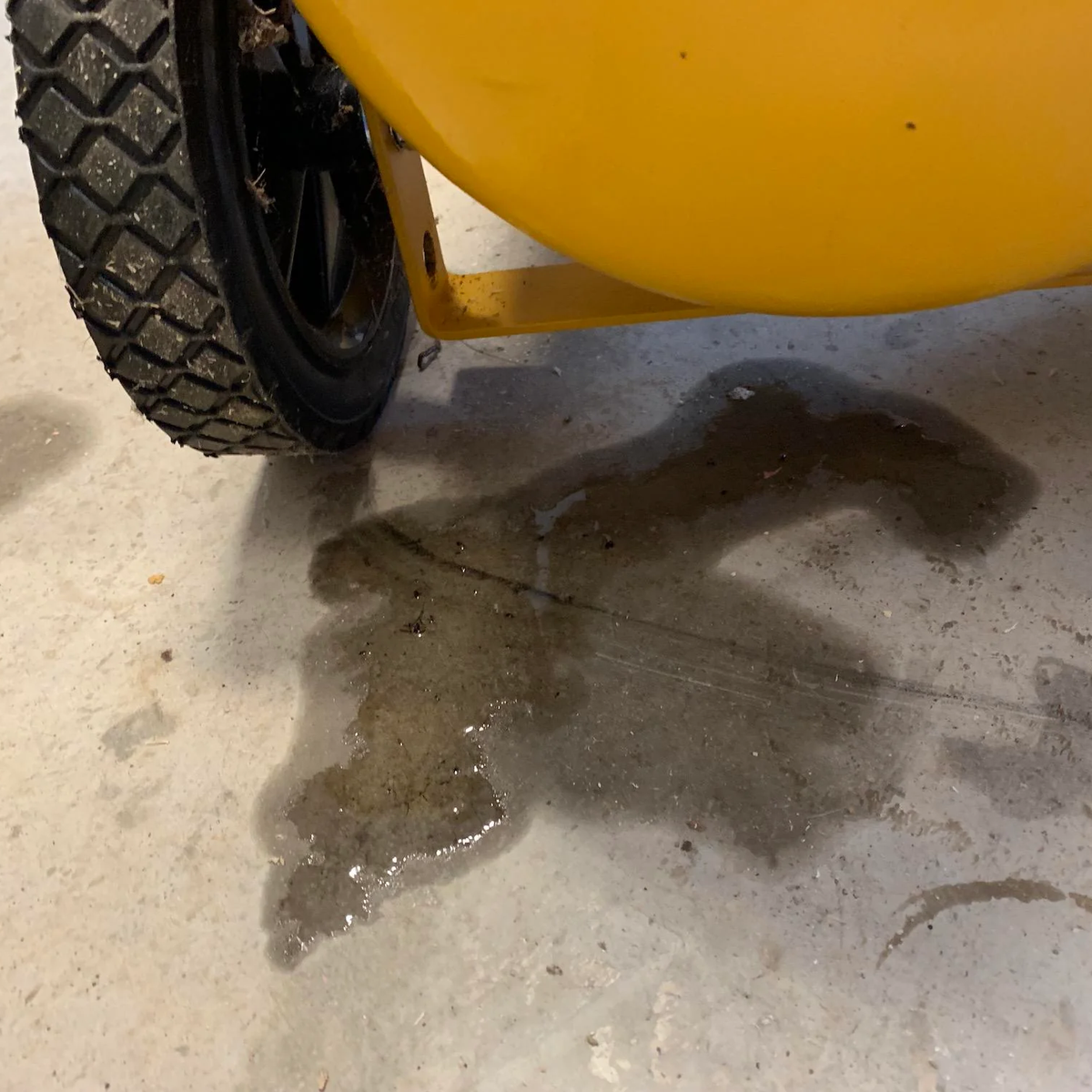
A puddle under the compressor is never a good surprise. Sometimes it is a drop of oil on the floor and a dark smear down the side of the pump. Sometimes it is a mist coating the shroud, the belt guard and your shoes. Either way, the first question we hear on the phone is the same: "Is it dead?"
Usually not. An air compressor leaking oil is almost always one of a short list of causes, and most of them are cheap to fix if you catch them early. Here is how to find where the oil is really coming from, what each location means, and what to replace.
Step one: clean it and watch it
Oil spreads. A leak at the top of the pump will end up on the floor, and you will blame the drain plug. Before you buy anything:
- Shut the compressor down, lock out the power, and bleed the tank pressure.
- Wipe the whole pump, crankcase, fittings and shroud with degreaser and a rag.
- Check the oil level while you are there, and note whether it is low, correct or overfilled.
- Run it for a short time under normal use and look for the first spot that turns wet again.
A dry, clean unit shows you the source quickly. If you want to be sure, a light dusting of foot powder or white talc near the suspected spot makes a fresh leak obvious.
Where oil leaks from a piston compressor
| Where you see oil | Likely cause | Typical fix |
|---|---|---|
| Around the head or between the head and cylinder | Failed head gasket or valve plate gasket | Replace the gasket set, check for warped surfaces |
| At the front or rear of the crankshaft | Worn crankshaft seal | Replace the seal, check the shaft for scoring |
| Dripping from the breather or filler cap | Overfilled crankcase, worn rings, or a plugged breather | Correct the oil level, check ring wear, clear the breather |
| At the drain plug or sight glass | Loose plug, failed washer or O-ring | Replace the washer or O-ring and tighten correctly |
| Oil in the air line or the tank | Ring wear, blow-by, overfill | Rebuild or replace the pump, see below |
Head gasket and valve plate leaks
This is the classic. Heat and vibration age the gasket, and eventually a little oil weeps out where the head meets the valve plate. You will often see a dark line of oil at the joint, and you may also lose pressure. On many pumps you are better off replacing the whole set (head gasket, valve plate gaskets and the reed valves) rather than the single gasket that failed. You can browse our compressor gaskets to match your pump. Torque the head bolts in the sequence and to the value in your manual, and do it in stages.
Crankshaft seals
An oil leak at the shaft usually means a worn seal. On a belt-driven pump you will see oil thrown onto the flywheel or the belt guard. Oil on a belt is a double problem, because it makes the belt slip and break down. Replace the seal, check the shaft where the seal rides for a groove, and replace the belt if it has been soaked.
Overfilled crankcase
More oil is not better. Too much oil in the crankcase gets churned up, foams, and gets pushed out the breather. Check the level with the compressor level and cold, and follow the manual. If you recently did an oil change and the leak started right after, this is the first place to look.
Worn rings and blow-by
If oil is spitting from the breather in a mist, or you are finding oil in the tank or downstream lines, the piston rings may be worn. Air blows past worn rings into the crankcase, builds pressure there, and pushes oil out through the breather and every weak seal. This is a pump rebuild or replacement question, not a gasket question. Our article on air compressors blowing oil into air lines covers the downstream symptoms.
Where oil leaks from a rotary screw compressor
Rotary screws carry more oil, under pressure, with more joints. Common leak points:
- Oil filter and housing. A loose filter, a damaged gasket or a cross-threaded spin-on. Always lubricate the new filter gasket with a little oil before you install it and tighten by hand to the filter maker's turns.
- Separator tank cover and flange. A cover gasket that has aged out will weep oil down the side of the tank.
- Hoses and fittings. Oil lines flex with heat. A hose that is cracked or crimped at the end is a likely culprit.
- Shaft seals. A leak around the airend or the motor coupling means a seal problem.
- Sight glass and drain. Check the O-rings.
On a screw machine, a sudden oil leak at pressure is a safety issue. Shut it down and depressurize before you touch anything. Stock O-rings and gaskets are inexpensive, so keep a set on the shelf. Browse our O-rings and oil filters for your model.
Is it leaking oil or carrying it over?
These are different problems. External leaks leave oil on the floor. Oil carryover sends oil through the system into your lines, tank and tools. If you see oil at the tank drain, a milky or oily condensate, or oil blowing from tools, you have carryover, and that points to rings, an overfilled sump, a failing separator element on a screw machine, or a missing filter. Our air compressor oil guide explains what to check and which oil to use.
How to fix it without making it worse
- Depressurize and lock out. Always.
- Identify the source using the clean and watch method above.
- Replace the whole wear item. If a gasket failed, replace every gasket in that service kit, since the rest are the same age.
- Use the right parts. Match the part number to your pump or compressor model. Look it up from the nameplate.
- Clean mating surfaces. Old gasket residue causes the next leak.
- Torque to the manual. Over-tightening crushes gaskets.
- Refill to the right level with the correct oil, and run it while watching for leaks.
Keeping it from happening again
Most oil leaks are maintenance leaks. A few habits cut them way down. Change the oil on the schedule in your manual and use the oil your pump calls for, because the wrong viscosity runs hotter and works seals harder. Keep the breather clean so the crankcase can vent. Tighten fasteners after the first few hours following any gasket job, since new gaskets settle. Keep the compressor in a room that does not run hot, and keep the belt guard clean so you spot a fresh drip early. A quick wipe-down and a glance at the oil level once a week catches nearly every leak while it is still a small one.
When to stop patching
If you are chasing leaks on an old pump every few months, the pump is telling you something. Heavy oil carryover, low compression and a smoking breather mean a rebuild or replacement is cheaper than another set of seals. For a compressor that runs a business, call us with the model number and we will tell you whether parts or a new unit makes more sense.
Frequently Asked Questions
Why is my air compressor leaking oil from the bottom?
Oil runs downhill, so the source is often higher. Check the drain plug first, then clean the pump and look for a head gasket or crankshaft seal leak that has run down to the base.
Can I keep running a compressor that leaks oil?
Not for long. A leak that drops the oil level can wreck the pump. Check the level, fix the leak, and do not run it low on oil.
What causes oil to come out of the breather?
Overfilling, a clogged breather, or worn rings pushing air past the pistons into the crankcase.
Is oil in my air tank normal?
A small amount of oil aerosol in condensate is normal on lubricated compressors, but heavy oil points to ring wear, overfill, or a failing separator on a screw machine.
Do I replace just the gasket that leaked?
Usually replace the full gasket set for that area. The rest are the same age and likely to fail next.


