


We get this call a lot. Somebody buys a compressor, sets it on the slab, pipes it up in hard copper, and a month later the office above the shop is complaining, a fitting has cracked, and the compressor has walked six inches toward the wall. Then they go looking for vibration pads.
Pads are sometimes the answer. Sometimes they are exactly the wrong answer and will make things worse. Which one depends entirely on what kind of compressor you bought, and that is the part nobody explains at the point of sale. So here is the whole picture on air compressor vibration isolation, including the part where the piping matters more than the mounts.
Pistons and Screws Are Opposite Problems
A reciprocating compressor makes big, slow, low frequency shakes. Pistons reverse direction twice per revolution and the whole package rocks. That energy has to go somewhere, and if the feet sit hard on concrete, it goes into the slab and out through the building.
A rotary screw makes small, fast, high frequency vibration. Two rotors turning at speed, no reciprocating mass, nothing slamming back and forth. The package is heavy and the vibration is comparatively minor.
That difference is why the advice flips:
| Reciprocating (piston) | Rotary screw | |
|---|---|---|
| Vibration character | Low frequency, high amplitude | High frequency, low amplitude |
| Isolation pads | Yes, one under each foot | Generally no |
| Anchor to floor | Often through the pads, lightly, or not at all on a portable | Yes, anchored to the slab |
| What controls the vibration | The isolator | The mass of the package on a solid foundation |
| Flexible discharge connector | Required | Strongly recommended |
That last row about screws surprises people, so it is worth being explicit: industrial installation guidance for rotary screw packages says not to mount them on vibration isolators. The reasoning is that a screw converts a lot of shaft power in a small space, and damping high frequency vibration takes mass, not springs. Set it on a rigid foundation, anchor it, and the package mass does the work. Put that same machine on soft mounts and you can end up with more package vibration, not less.
Always follow the manual for your specific machine. Manufacturers differ, and some screw packages ship with their own internal isolation already designed in.
Mounting a Piston Compressor
For a stationary reciprocating unit, whether it is a 5 hp two stage in a home garage or a 15 hp on a vertical tank in a shop:
- Get it level and get it flat. A rocking compressor on an uneven slab will crack a foot. Shim it so all four feet carry load before you tighten anything.
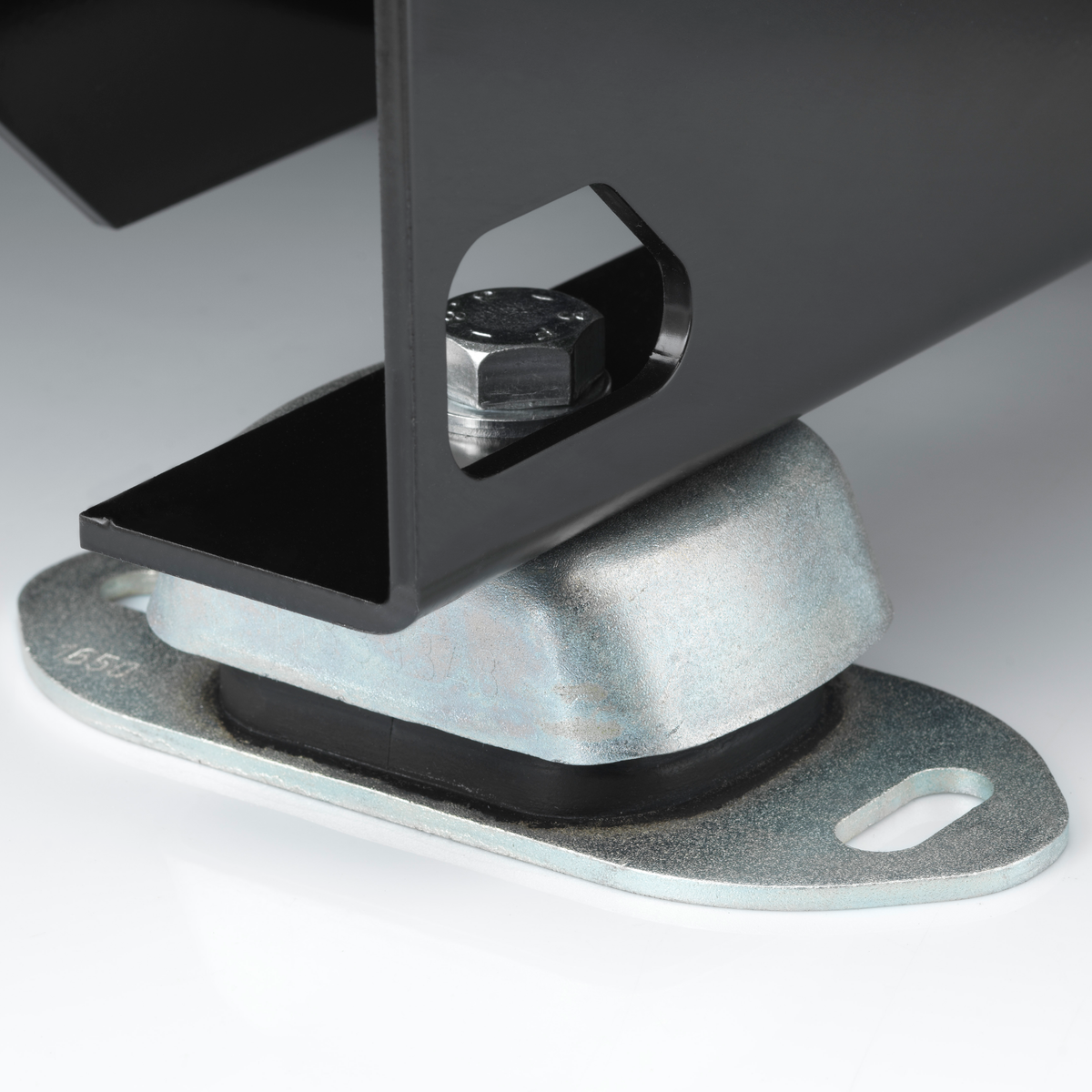
- One pad per foot. The common industrial pad is two neoprene sheets bonded to a cork core, and they are sized by load. The pad has to be loaded properly to deflect and do its job. Four pads under a machine far lighter than their rating do very little.
- Do not crush the isolation with the bolt. This is the mistake that undoes the whole install. If you run an anchor through the pad and torque it down hard against the slab, the bolt becomes a solid path and the pad is decoration. Many manufacturers call for leaving the hardware loose, or using a nyloc nut backed off so the machine is captured but not clamped, plus a rubber grommet or sleeve isolating the bolt from the foot.
- Anchor if it walks. A tank mounted unit that moves under load is a hazard and a hose failure waiting to happen. Capture it. Just capture it without short circuiting the isolation.
Mounting a Rotary Screw
Different job entirely. The goal here is a rigid, flat, heavy foundation.
- Slab. Typical guidance is a minimum of six inches of reinforced concrete, with a housekeeping pad recommended. Check the load numbers in your manual against what your floor actually is, especially in an older building or on a mezzanine.
- Level and grout. Shim to level, then grout the base where the manual calls for it. Grout couples the package to the foundation, which is exactly what you want on a screw.
- Anchor bolts. Use them, torqued per the manual.
- Eliminate pipe strain. Firmly anchoring the package and removing piping stress from the compressor connection is the single best thing you can do for a trouble free install. More on that next.
The Part Most People Skip: The Discharge Connection
Here is where the real damage happens, and it is not the mounts.
If you hard pipe a compressor directly into a rigid header, the package moves and the pipe does not. Something has to give. Usually it is a threaded joint at the compressor, or a weld, or the discharge port on the machine itself. On a piston unit it can also be the tank nipple. We have seen brand new installs crack a discharge fitting inside a month because somebody ran three feet of hard copper straight off the pump.
A flexible connector between the compressor discharge and the first pipe anchor solves it. Braided stainless flex hose is the usual choice: it absorbs the mechanical vibration and the pulsation surges that reciprocating machines produce, and it keeps that energy from reaching the rigid piping and the building structure. The install rules are simple:
- Put it between the compressor discharge and the first rigid support. That is the whole point. A flex connector installed downstream of a pipe anchor does nothing.
- Do not use it to correct a misalignment. Flex connectors absorb vibration, they are not a way to make two pipes that do not line up meet.
- Do not compress or stretch it at install. Install it at its neutral length.
- Rate it for the discharge temperature, not just the pressure. Compressor discharge can run well above 200F, and that rules out a lot of rubber.
- Support the pipe on the far side. The flex connector is not a hanger.
The same logic applies to the rest of the run. Isolate pipe hangers where the header passes a wall or a ceiling joist, take branches from the top of the header, and do not let a long unsupported run hang off the machine. Our air pipe and fittings and piping accessories cover the hardware, and if you are planning a layout from scratch, our guide on installing compressed air lines walks through it.
When New Vibration Means Something Is Broken
Everything above is about a healthy machine. If a compressor that ran smoothly for years suddenly starts shaking, do not go buy pads. Something changed. Check in this order:
- Loose hardware. Mounting bolts, flywheel bolt, motor bolts, pulley setscrews. Easiest thing on the list and a common answer.
- Belt and sheave alignment. A worn belt or a sheave that has crept on the shaft will produce a shake you can feel. Our belt sizing and tension guide covers what good looks like.
- Valve trouble. On a piston, a broken reed or a leaking valve plate changes the load on each stroke and the machine runs rough.
- Coupling or motor bearing. On a direct drive screw, a failing coupling element or a bearing going bad shows up as vibration first and noise second.
- The foundation itself. Cracked grout, a spalled slab under one foot, or an anchor that has pulled. Get down and look.
Vibration is data. A machine that suddenly starts telling you something is usually right.
Frequently Asked Questions
Do vibration pads actually work on an air compressor?
On a reciprocating compressor, yes, when they are sized for the load and the mounting bolt is not clamping them solid. On a rotary screw, generally no. Industrial installation guidance for screw packages calls for anchoring to a rigid foundation rather than mounting on isolators, because mass is what damps high frequency vibration.
Should I bolt my air compressor to the floor?
A rotary screw, yes, per the manual, on an adequate slab. A stationary piston compressor should be captured so it cannot walk, but not clamped down so hard that the anchor bolt short circuits the isolation pads. Use grommets or sleeves so the bolt does not touch the foot metal directly.
What thickness of concrete does a compressor need?
Common guidance for an industrial rotary screw package is a minimum of six inches of reinforced concrete, with a housekeeping pad recommended. Always check the actual weight and footprint of your machine against the manual, because a large package on an old thin slab is a real problem.
Where does the flexible connector go?
Between the compressor discharge and the first rigid pipe anchor or support. Installed anywhere downstream of that first anchor, it does nothing, because the vibration has already been transmitted into the piping.
Can I use rubber hose instead of a metal flex connector?
Only if it is rated for the actual discharge temperature and pressure, and many are not. Compressor discharge can exceed 200F. Braided stainless flex is the safer default for a permanent discharge connection, and it handles pulsation from a reciprocating machine better than rubber.
The Short Version
Pistons get pads and a loose capture. Screws get a thick slab, grout, and anchor bolts. Both get a flexible connector between the discharge and the first pipe anchor, and neither one gets hard piped into a rigid header. Do those three things and air compressor vibration isolation stops being a problem you have to solve later.


