


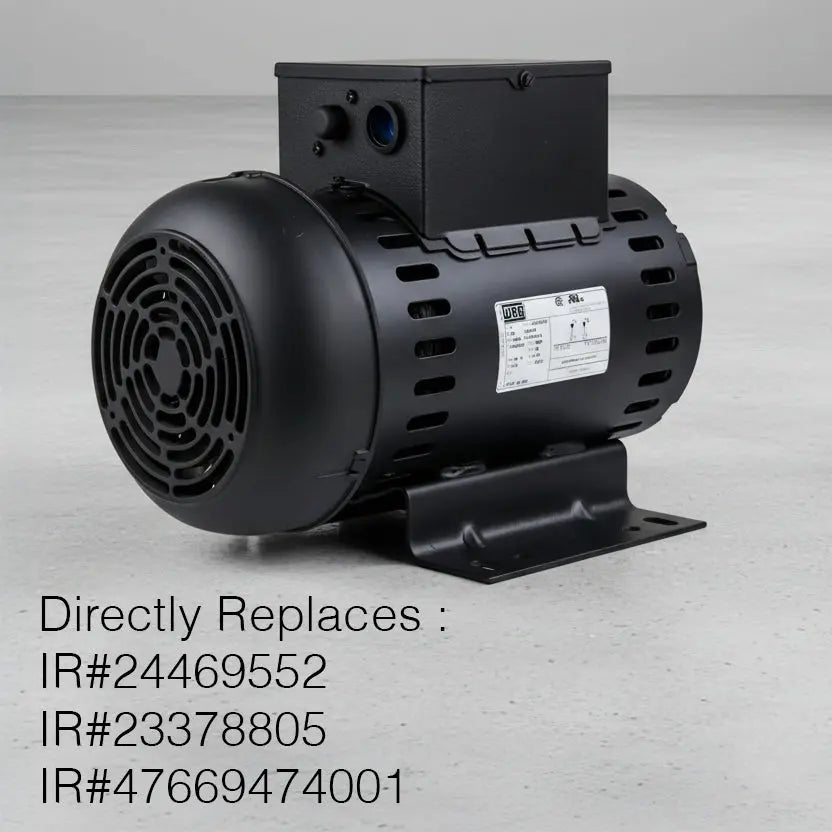
Your compressor motor finally gave up. Maybe it hums and won't spin, maybe it trips the breaker, maybe it just sat down and quit. Now you're staring at a parts page wondering which replacement actually fits. Pick the wrong air compressor motor and it either won't bolt up, won't make the air you need, or won't run on the power you have.
The good news is that choosing the right motor comes down to reading a few numbers off the old one and matching them. Let's walk through it the way we would if you called us with the nameplate in your hand.

Start with the nameplate
Before you shop, find the metal nameplate on the side of your old motor and write down everything on it. That plate tells you horsepower, RPM, frame size, voltage, phase, and service factor. Nine times out of ten, the right replacement air compressor motor is the one that matches those numbers. If the plate is rusted off or unreadable, the pump's data plate or your owner's manual will get you close.
Match these four things
1. Horsepower (HP)
Horsepower has to match the pump, not just the old motor. Going bigger does not make more air, because the pump can only do what it's designed to do. Going smaller overloads the motor and burns it up. Match the HP the pump calls for.
2. RPM
This one trips people up. Most small, portable pumps spin at around 3,450 RPM (a 2-pole motor). Larger stationary pumps usually run near 1,750 RPM (a 4-pole motor). Airflow scales with shaft speed, so dropping from a 3,450 to a 1,750 motor roughly cuts your output in half. Match the RPM of the original.
3. Frame size
Frame size sets the bolt pattern, shaft diameter, and shaft height. A 56 frame and a 182T frame do not interchange without an adapter. Match the frame and the new motor drops right onto the existing base and lines up with your pulley.
4. Voltage and phase
This is about the power coming into your building, covered in detail below. Get it wrong and the motor either won't run or won't run safely.
Single-phase vs three-phase
The biggest fork in the road is single-phase versus three-phase power. Here's how they stack up.
| Factor | Single-Phase | Three-Phase |
|---|---|---|
| Power needed | Standard 120V or 240V | 208V, 230V, or 460V three-phase |
| Best for | Home shops, small compressors | Larger compressors, all-day use |
| Startup | Lower starting torque, spins up slower under load | High starting torque, smoother |
| Longevity | Runs hotter, more vibration | Less heat, fewer breakdowns |
If you have three-phase power in the building, use it, especially at 5 HP and up. Three-phase motors are cheaper to buy, start harder, run cooler, and last longer. Big single-phase motors (7.5 HP and up) are expensive and hard to find. Before you fight a conversion, call your power company. Three-phase service is sometimes available at your address for a modest monthly fee.
Open drip-proof or TEFC?
You'll also choose an enclosure. Open drip-proof (ODP) motors are cheaper and run cool in clean, dry, indoor shops. Totally enclosed fan-cooled (TEFC) motors seal out dust and moisture and are the better call for dirty, humid, or outdoor spots. When in doubt in a working shop, TEFC buys you peace of mind.
Don't forget the starter
A new motor often wants a properly sized magnetic starter or overload to protect it. If your old setup just used a pressure switch, confirm the motor's full-load amps are within what that switch can handle, or add a starter. We stock matching starters and overload relays so the whole package plays nice.
Repair or replace?
A motor that's tripping on a bad capacitor or worn bearings can sometimes be fixed cheaply. But once windings are burned, replacement is almost always the smarter money, and a new compressor-duty motor comes with the hard-start design these pumps demand. If the old motor is more than a decade old and out of warranty, replace it and move on.
Frequently Asked Questions
What size motor do I need for my air compressor?
Match the horsepower the pump is rated for. A bigger motor will not make more air, and a smaller one will overload and fail. Read the HP off the old motor or pump nameplate.
Can I put a single-phase motor on a compressor that had three-phase?
Only if a single-phase motor is available in the right HP, RPM, and frame, and your wiring supports it. Large single-phase motors are costly and hard to find, so if three-phase power is available, it's usually the better route.
Why does RPM matter on a replacement motor?
Airflow scales with shaft speed. Swapping a 3,450 RPM motor for a 1,750 RPM motor roughly halves your output, so always match the original RPM.
What is a compressor-duty motor?
It's a motor built for the hard, repeated starts an air compressor demands, with higher starting torque and a service factor suited to that load. A standard general-purpose motor often won't hold up.
Bottom line
Choosing an air compressor motor is mostly a matching game: read the nameplate, match horsepower, RPM, frame, and voltage and phase, then pick the right enclosure and starter. Do that and the new motor bolts on and runs like the old one did on its best day.
Need a replacement? Shop compressor-duty motors, or send us your motor data plate and we'll match it for you.


